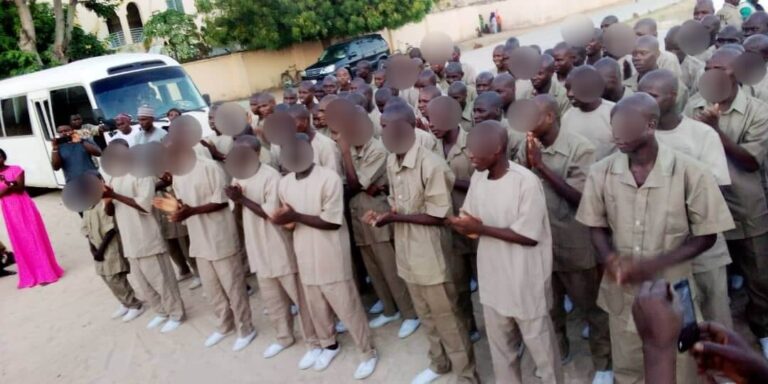
The decision by the Borno State Government to reintegrate over 1,000 repentant Boko Haram fighters into the society has generated animosity by some Internally Displaced Persons (IDPs) in the North-East.
The IDPs’ animosity is based on the fact that they are still languishing in pain and grieve caused by the activities of the Boko Haram terrorists in the North-East, particularly in Borno State, the core center of the insurgency.
Since its campaign to create an Islamic caliphate started around 2009, the Boko Haram sect has reportedly killed over 70,000 people and displaced about 2.5 million people, according to estimates by the International Crisis Group.
Of the displaced, at least 250,000 have reportedly left Nigeria and fled into the neighboring countries of Cameroon, Chad, and Niger, though Borno State has started receiving some repatriated refugees from the countries.
The military onslaught on the terrorists has reportedly led to the deaths of many of the insurgents, while some of them have reportedly surrendered to the army.
In a statement on Tuesday, the army said “All surrendered terrorists will be received, processed and passed on to the relevant agencies of government for further assessment in line with extant provisions.”
The Borno State Government has also announced its readiness to accept and reintegrate the repentant terrorists into society.
According to The Punch, the state Commissioner for Information, Culture and Home Affairs, Mr. Babakura Jatau has equally begged host communities to accept the ex-Boko Haram fighters as one of them.
Jatau said, “At the end of every war, there is reconciliation. Every single war is not ended by the power of the bullet and bomb. They (insurgents) are part and parcel of us. They have surrendered; they are radicalized and they now realize their mistakes.
“Remember, we have been dealing with this problem for the past 13 years. For the past 13 years, the Federal Government has been battling with this insurgency without any peaceful resolution through firepower.
However, IDPs in various camps in Borno have rejected the state government’s decision to reintegrate ‘repentant’ terrorists into society.
They argued that they are in a terrible situation because of the activities of Boko Haram members.
Modu Abubakar, one of the IDPs, who spoke to The Punch said he and his seven children narrowly escaped death when the insurgents attacked their village seven years ago.
He said he lost all his properties and source of livelihood as a result of the attack.
Another IDP, Mustapha Musa, a 53-year-old indigene of Kukawa town in Kukawa Local Government Area of Borno State, said he could not forget the pain Boko Haram had caused him.
“I used to have a car which I used for my fishing business. One night, Boko Haram came, destroyed my business, and rendered me homeless,” he said.
Also, Mama Hajara, a 47-year-old mother of five who fled from Gwoza in Borno State said it would be impossible to change repentant terrorists’ ideologies.
“I don’t believe that those Boko Haram fighters looking for reintegration have genuinely repented. So I will advise the army and other security agencies in the theatre of the war to use their intelligence in dealing with these people.
“How does the government want a woman whose husband was killed by Boko Haram to feel when she sees a so-called repentant Boko Haram? How would a woman whose child or children were killed by the terrorists feel?” she asked.
Also, a pastor of the EYN Church from Chibok, Borno State, who fled to Jalingo, Taraba State, urged the government to be careful with the idea of reintegrating the repentant terrorists.
“The government must tread with caution the idea of reintegrating repentant terrorists before some sections of the country begin to compare the treatment given to terrorists and freedom fighters like Sunday Igboho and Nnamdi Kanu,” he said.
Meanwhile, some IDPs said they were happy to hear the news that some Boko Haram terrorists had started surrendering.
Isa Maina, an indigene of Dambo’a in Borno State and is the secretary for IDPs’ association in Gombe State, said he fled Dambo’a with his two wives, one of whom was pregnant, in 2014 when insurgents attacked the village.
“I have suffered but I’m happy to hear that they are surrendering, and I hope this will mark the beginning of the end to the insurgency,” he said.
Another IDP, Sambo Mohammed, 60, from Talala in Borno State, urged the government to compensate the victims of insurgency.
“Our plight today is as a result of the insurgents’ activities. It would be nice for the government to consider compensating us for our losses,” he said.
Moreover, this is not the first time the government would be reintegrating surrendered Boko Haram members into society.
Brigadier Gen. John Sura (retd.), a former Chairman of Training and Operations at the Military Headquarters in Abuja has advised the Federal Government to deploy repentant Boko Haram terrorists to the farm.
Sura said the repentant terrorists should be used to cultivate agricultural products that they deprived the Internally Displaced Persons and other Nigerians to produce.
However, some former military generals have cautioned the government on plans to reintegrate former Boko Haram terrorists into society.
Ada Peter