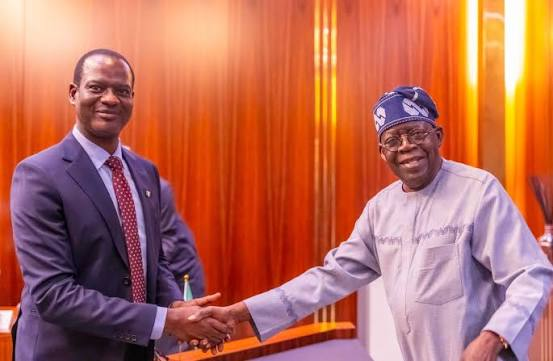
President Bola Tinubu has reaffirmed his administration’s commitment to improving electricity supply and enhancing livelihoods across Nigeria. He made the pledge during a meeting with Siemens Energy officials, led by Dietmar Siersdorfer, Managing Director for Middle East and Africa, at the Presidential Villa in Abuja.
Tinubu stressed that a stable power sector is crucial for industrial growth, education, and healthcare development. He directed the expansion of major transformer substations from two to three phases to increase national electricity capacity.
Vice President Kashim Shettima, Coordinating Minister of the Economy Wale Edun, Minister of Power Adebayo Adelabu, and Special Adviser on Energy Olu Verheijen were also in attendance.
Minister Adelabu highlighted recent milestones in the power sector, including the commissioning of mobile substations and transformers that added 984MW of transmission capacity. He noted that Phase One of the Presidential Power Initiative (PPI) is underway, with five key substations being upgraded and new ones planned nationwide, collectively expected to add 4,104MW. Two of the five substations under construction are projected for completion by December 2026.
The PPI also aims to train local engineers, create jobs, and boost local content. Siersdorfer described the initiative as “a platform for long-term development,” emphasizing that Nigerian professionals will be directly engaged at project sites, with thousands more benefiting indirectly through community involvement.
Finance Minister Edun added that the project will enhance Nigeria’s ease of doing business and reduce poverty. Meanwhile, a representative of the German Ambassador assured continued support from Germany.
“The PPI is not just a project but a platform for long-term development and prosperity,” Siersdorfer said, highlighting the deepening Nigeria-Germany partnership in energy development.