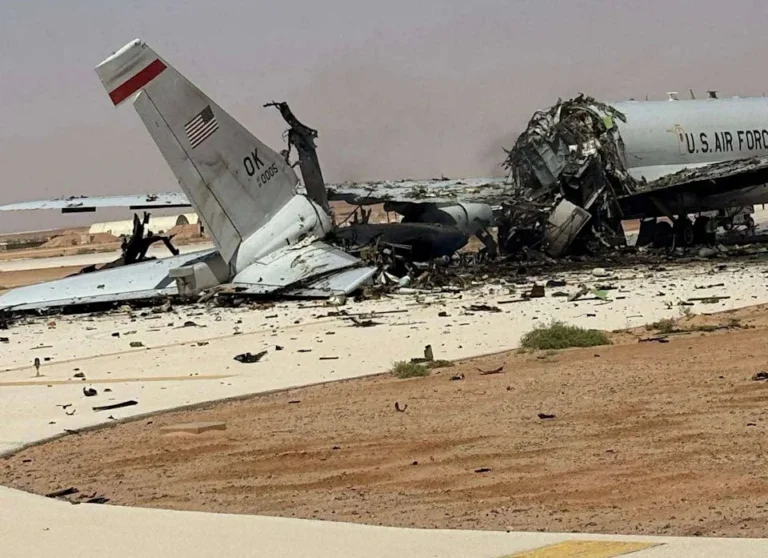
The destruction of a U.S. Air Force E-3 Sentry by Iran has raised alarm among military analysts, who warn the loss could weaken America’s ability to detect and respond to aerial threats.
Images circulating after the strike show the aircraft severely damaged, with its tail section apparently torn off. The plane was part of the U.S. military’s airborne warning and control system (AWACS), a fleet now reduced to roughly 16 operational aircraft.
Several of these planes had been stationed at Prince Sultan Air Base prior to the attack, which occurred on March 27 and also left multiple U.S. service members injured.
The E-3 Sentry plays a central role in modern air warfare, functioning as an airborne command center capable of tracking hundreds of targets across vast distances. Analysts describe the aircraft as essential for coordinating operations and providing a comprehensive view of the battlefield.
“They’re the chessmaster,” said Heather Penney, a former fighter pilot, emphasizing the aircraft’s role in directing other assets in combat scenarios.
Experts say losing even a single AWACS platform is significant. Cedric Leighton, a retired Air Force colonel, described the loss as a “serious blow” to U.S. surveillance and command capabilities.
The strike highlights the growing risks to high-value military assets as the conflict with Iran intensifies, raising concerns about potential gaps in early warning systems and airspace coordination.