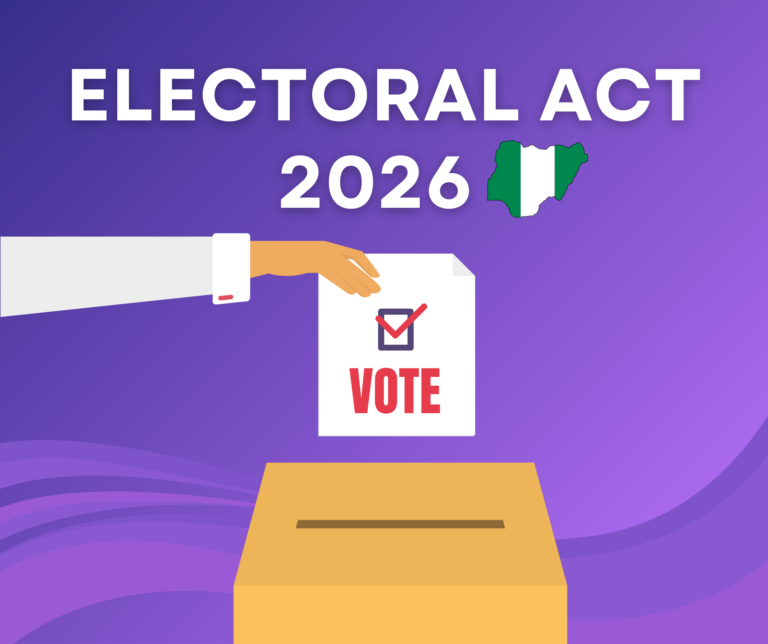
Nigeria’s newly promulgated Electoral Act 2026 has introduced major reforms to the country’s electoral system, including restrictions on court interference in the internal affairs of political parties and tougher penalties for electoral malpractice.
Under Section 83(5) of the law, courts are barred from entertaining suits related to the internal matters of political parties. The provision states that no court in Nigeria shall assume jurisdiction over disputes concerning a party’s internal affairs.
The Act further stipulates that where such suits are filed, courts must not grant interim or interlocutory injunctions. Instead, rulings are to be reserved until final judgment, with the cases given accelerated hearing. The law also imposes financial sanctions of not less than ₦10 million each on both the plaintiff and the counsel who institute such cases, in addition to any legal costs incurred by the Independent National Electoral Commission (INEC) if it is joined as a party.
The Act outlines stricter procedures for the merger of political parties. Under Section 81(1), parties seeking to merge must submit a formal request to INEC at least nine months before a general election.
The application must be jointly signed by the national chairman, secretary and treasurer of the parties involved and must include a special resolution approving the merger passed at each party’s national convention. It must also contain the proposed name, acronym, constitution, manifesto and symbol of the new party, along with proof of payment of administrative fees set by the commission.
INEC is required to respond within 60 days. Where the commission fails to communicate its decision within that timeframe, the parties may challenge the delay in court within 14 days, provided they demonstrate compliance with all constitutional requirements.
The law significantly increases penalties for electoral offences. Vote buying or selling now attracts a fine of ₦5 million, a minimum prison term of two years, or both. Offenders will also be barred from contesting elections in Nigeria for at least 10 years.
Similarly, anyone found unlawfully possessing or selling a voter’s card faces the same penalties.
The Act also criminalises the appointment of members of political parties into positions within INEC. Individuals who conceal their party affiliation to secure such appointments risk a ₦5 million fine, up to two years’ imprisonment, or both.
Political parties must now submit their list of candidates to INEC at least 120 days before an election. Each candidate must provide an affidavit sworn before a court confirming compliance with constitutional eligibility requirements.
Candidates who wish to withdraw from an election must do so at least 90 days before the election date.
The law also invalidates nominations where a candidate knowingly accepts nomination from more than one political party or in more than one constituency.
Additionally, candidates who lose party primaries but later challenge the process in court cannot be declared winners of an election that has already been concluded. In such situations, courts may only order a fresh election with the originally winning party excluded.
The Act introduces a National Electronic Register of Election Results to be maintained by INEC for digital storage of polling unit and collated results nationwide. Certified copies of the records may be obtained by individuals or political parties upon payment of prescribed fees.
Presiding officers are required to electronically transmit election results, including the total number of accredited voters, to the next level of collation. Any officer who deliberately violates this requirement faces a minimum fine of ₦500,000, at least six months’ imprisonment, or both.
Returning or collation officers who intentionally announce or collate false election results face a minimum prison sentence of 10 years without the option of a fine.
The law also bars appointed or elected government officials who have not resigned their positions from serving as polling or collation agents for political parties.
Overall, the Electoral Act 2026 seeks to strengthen transparency in result management, curb electoral malpractice and redefine the role of courts in resolving party-related disputes.