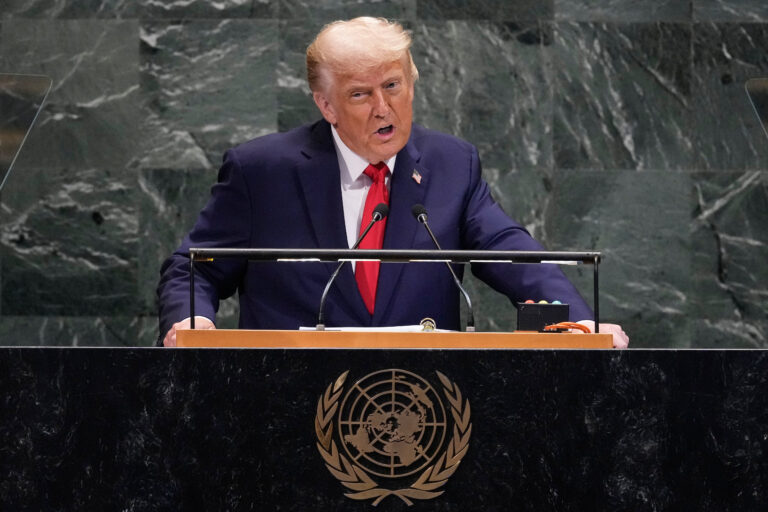
U.S. President Donald Trump launched a blistering critique of international climate change initiatives during his address to the United Nations General Assembly on Tuesday, calling them “the greatest con job the world has ever seen” and accusing global leaders of sacrificing prosperity in pursuit of unproven environmental policies.
Speaking before world leaders gathered in New York for the 80th session of the General Assembly, Trump argued that climate policies have become expensive political dogma that endanger national economies without delivering measurable benefits.
“They are spending trillions of dollars, and for what? The world is getting poorer,” Trump declared. “Climate change is the greatest con job the world has ever seen.”
Framing the issue as a matter of economic sovereignty, Trump warned that global environmental agreements are pushing nations to “shut down industries, close power plants, and sacrifice our people’s prosperity” based on what he described as unproven scientific models.
“We are being told to dismantle our economies for vague promises and abstract goals,” he said, adding that these strategies have done little to slow environmental degradation but have significantly hampered job creation and raised energy prices.
Trump accused world leaders of being beholden to what he termed the “climate mob,” while insisting that the United States would continue to put its national interests first.
“We are not here to bow to the climate mob,” he said. “We put America first, and other nations should do the same.”
The president was particularly critical of multilateral climate accords promoted by the United Nations and other international bodies, calling them “political exercises” disconnected from economic realities.
“These agreements are crafted by bureaucrats who think they know better than the people they claim to serve,” he said. “We must act in the real world, not in a fantasy dictated by ideology.”
Trump warned that continued adherence to what he sees as flawed environmental policies would only lead to stagnation, energy insecurity, and increased poverty.
While he did not directly cite any specific agreements, Trump’s remarks appeared to take aim at frameworks like the Paris Climate Accord, which he withdrew the U.S. from during his first term. He repeated long-standing criticisms that such deals disproportionately burden industrial economies while giving developing nations a free pass.
“The world must focus on reality, not ideology, if we want prosperity and security for our people,” he said.
Trump’s address is expected to draw sharp responses from European leaders and environmental advocates, many of whom have made climate action a cornerstone of their UN agenda this year. However, his message is also likely to resonate with countries concerned about the economic costs of rapid decarbonization.
As the UN continues to push for coordinated global climate action, Trump’s remarks highlight the deep divisions over how — and whether — to address the planetary crisis through collective means.