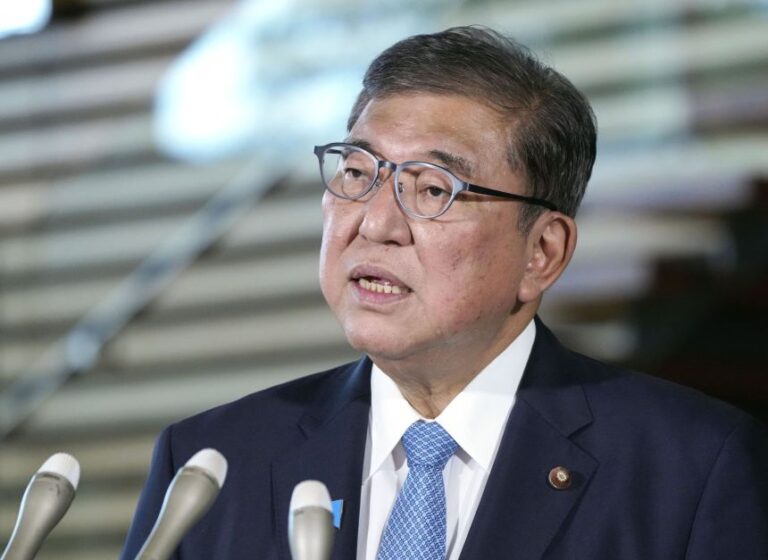
Japan’s Prime Minister Shigeru Ishiba announced his resignation on Sunday, bowing to intensifying pressure from within his own Liberal Democratic Party (LDP) to take responsibility for the party’s crushing defeat in July’s parliamentary elections.
Ishiba, who assumed office last October, had resisted calls to step down for over a month, warning that his departure could trigger a political vacuum during a period of significant domestic and international challenges. However, facing an imminent leadership revolt, Ishiba ultimately conceded, declaring at a nationally televised press conference that he would initiate a leadership election to select his successor, effectively rendering a scheduled Monday vote by the party moot.
“The country cannot afford further political instability,” Ishiba said. “I will take responsibility and allow a new leader to guide the party forward.”
The resignation follows the LDP’s historic loss of its upper house majority in July, a setback that compounded earlier defeats in the lower house and weakened the coalition’s grip on power. Party leadership, especially from the right wing, had grown increasingly vocal in demanding Ishiba’s resignation, citing the need for a “complete overhaul” of the party’s direction.
Over the past week, momentum against Ishiba accelerated. High-profile figures such as former Prime Minister Yoshihide Suga, Agriculture Minister Shinjiro Koizumi, and Finance Minister Taro Aso—a longtime critic of Ishiba—urged him to step aside. Several Cabinet ministers and deputy ministers also began aligning with calls for an early leadership contest, forcing Ishiba’s hand.
Ishiba’s decision to resign came just one day before a crucial party meeting where the LDP was expected to vote on holding an early leadership election—a move that would have effectively served as a vote of no confidence in his leadership.
By stepping down voluntarily, Ishiba avoided a public rejection by his party but acknowledged the deep divisions within his administration and the difficulty he would face in leading a fractured minority government forward.
Ishiba’s short tenure was marked by economic turbulence, trade tensions with the United States, and rising geopolitical instability in the Asia-Pacific region. He had defended his leadership by stressing the importance of continuity during a time of rice policy reform, surging inflation, and diplomatic uncertainty.
But party leaders argued that change was necessary to regain public confidence. The LDP’s recent internal review of the election results had already called for a “total reset” of the party’s strategy and image.
With Ishiba out, attention now turns to who will succeed him and whether the LDP can reunite ahead of future political battles. While no clear frontrunner has emerged, names like Shinjiro Koizumi and Taro Aso are expected to be influential in shaping the next phase of party leadership.