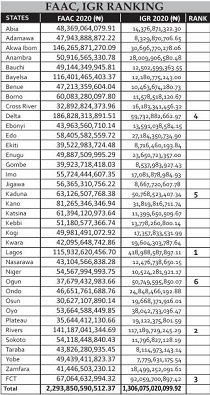
Dread seems to be the mood in most government spheres across the 36 states of Nigeria as the certainties of the cash crunch induced by the COVID-19 pandemic continue to bite harder. Revenue is plunging as evident in the Internally Generated Revenue at State Level (Q4 and Full Year 2020) report just published by the National Bureau of Statistics. The report says total revenue (federal allocation and internally generated) accruing to the states and the FCT went down from N3.8 trillion in 2019 to N3.599 trillion in 2020.
No sooner had Governor Godwin Obaseki dropped the bombshell, penultimate week, about the hazardous position of the national economy then the Kaduna State Government made clear its plan to downsize its workforce of close to 100,000.
Complaining about dwindling revenue, Muyiwa Adekeye, spokesman to Governor Nasir El-Rufai, said: “Government finances have been severely spanned by higher wage bills at a time when revenues from the Federation Account Allocations Committee (FAAC) have not increased.”
He recalled how in November 2020 the state government had “only N162.9 million left after paying salaries.”
According to him, the state received only N4.83 billion from FAAC that month and paid N4.66 billion as wages.
“In the last six months, personnel costs have accounted for between 84.97 percent and 96.63 percent of FAAC transfers received by the state government,” he said.
The news was no less discomforting from neighboring Kano State where the government, after weighing all options, decided to stop the payment of N30,000 minimum wage to its workers.
It reverted to the previous wage scale of N18,000 in December, drawing the ire of the Nigeria Labour Congress (NLC) which served notice of an industrial action except the decision was reversed.
It turned out to be a feeble move for the strike was suspended even before it took off.
National President of NLC, Ayuba Wabba, said the decision to suspend the strike was reached after an emergency meeting with a government delegation led by Head of Service (HoS), Hajiya Binta Ahmed.
Other states are weighing their options while workers and the general public wait anxiously for what is to come.
In Ogun State, pensioners are praying and hoping that the delay in the payment of their March stipends does not continue.
They were used to receiving their pensions at the end of every month, but the story changed in March when the money failed to come as usual. The reason has been that there was a shortfall in federal allocation.
It was gathered that the state’s revenue shortfall for the month was N692,354,252.06k.
How long the states will have to endure the allocation shortfall is not quite certain. Not with the fluctuating price of crude oil in the international market and not with the not too rosy picture painted by the National Bureau of Statistics in its report released on Friday. And not with the admission by governors elected on the platform of the ruling All Progressives Congress (APC) of cash crunch in the states.
In Kaduna State, government workers and political appointees are all in jitters as the government continues to compile the names of those to be laid off.
Although the government is yet to say how many of its workforce of less than 100,000 will be laid off in the planned retrenchment, the state NLC fears no fewer than 4,000 local government workers will lose their jobs.
Justifying its move, the state government said: “The public service of the state with less than 100,000 employees (and their families) cannot be consuming more than 90% of government resources with little left to positively impact the lives of the more than nine million that are not political appointees or civil servants. It is gross injustice for such a micro-minority to consume the majority of the resources of the state.
“In the last six months, personnel costs have accounted for between 84.97% and 96.63% of FAAC transfers received by the Kaduna State Government.
In March 2021, Kaduna State had only N321 million left after settling personnel costs. That month, the state got N4.819bn from FAAC and paid out N4.498bn, representing 93% of the money received.
“This does not include standing orders for overheads, funding security operations, running costs of schools and hospitals, and other overhead costs that the state has to bear for the machinery of government to run, for which the state government taps into IGR earnings.
“The government was elected to develop the state, not just to pay the salaries of public servants. It was elected to promote equality of opportunity, to build and run schools and hospitals, upgrade infrastructure and make the state more secure and attractive to the private sector for jobs and investments.
“In September 2019, Kaduna State Government became the first government in the country to pay the new minimum wage and consequential adjustments. The state government followed this up by increasing the minimum pension of persons on the defined benefits scheme to N30,000 monthly.”
In the case of Kano State, it was gathered that the government reverted to the old wages scale last November without any notice to the workers.
The workers only got to know about the cut when they received their salaries for the month.
The government blames its decision on dwindling funds brought about by the COVID-19 pandemic; the same reason adduced by the Taraba State Government for the non-implementation of the new national minimum wage.
But the State Joint Public Service Negotiating Council (SJPSNC) is not having any of that.
Its chairman, Dame Buhari, and the secretary, Tukur Taji, said in a statement in Jalingo, the state capital that “recklessness and wastage in managing the state’s resources” were the reasons government was not living up to its responsibility to its workers.
Osun: We’re blocking leakages
Osun State Political and Intergovernmental Relations Commissioner Taiwo Akeju admitted that the state has its share of the paucity of funds but will continue to block leakages in the system.
“We’re doing very well to block the leakages. This is helping us a lot,” Akeju said in an interview in Osogbo
He ruled out retrenchment in the public service despite the cash flow challenge, saying: “We are not going to sack, downsize or reduce the welfare of our workers because they have been very supportive and adding value to the service of the state.
“We are lucky in Osun that we have capable hands which Governor Oyetola only uses his business sense to annex the resources of the state. Since he commenced his administration, Osun has not borrowed from banks to run his government.
We’ve been proactive in Ekiti, says commissioner
Ekiti State Information Commissioner Akin Omole said the state has been proactive in its handling of the cash flow challenges by cutting down on the cost of governance.
“There’s no doubt that the economy of the country is in negative mode. Here in Ekiti, we have already cut the avoidable cost of governance,” the commissioner told The Nation in Ado Ekiti.
Like Osun State, he said there is no plan to retrench workers.
His words: “We are not going to retrench here in Ekiti. The cost of governance is all about what the government spends in discharging its duties. The essential areas, we will keep it, but all the avoidable have been cut to cope with the current economic situation.”
He said the government was compelled to take such proactive steps to sustain the execution of its various legacy projects across the state within the context of the current economic vulnerabilities in the country.
He did not elaborate on the pro-active steps taken by the government.
Niger adapting to the situation
The Niger State Government is adjusting to the dwindling allocation from Abuja, according to the Secretary to the State Government (SSG), Alhaji Ahmed Matane.
But the state is working hard to improve internally generated revenue to make up for the shortfall.
Matane said that in addition to boosting the IGR, the government is also cutting down the cost of governance in the state.
He did not say how.
“These are the two activities that can help us as a state to adjust to the downward spiral of the FAAC allocation. This is what we will continue doing until the allocation improves,” he said.
Previous efforts by the state government to slash workers’ salaries were resisted by the NLC.
It had planned to slash salary by 40 percent with a promise to pay the balance when the financial status of the state improves.
Prudence is key in Imo says Emelumba
The Imo State Government says it has no cause to complain now as it has always managed the resources available to it prudently.
Information Commissioner Declan Emelumba said: “This government is managing its resources prudently and the government is not complaining.
“From day one, this government has always prudently managed the resources of the state and that’s why even in scarcity, the governor has been doing road construction which is very expensive and has been paying salaries as at when due.”
‘Cross River has always been ready for a time like this
The Special Adviser Media and Publicity to the Governor Ben Ayade of Cross River State, Mr. Christian Ita, said the governor knew from day one that a time of cash crunch like this would come, hence his decision to focus on industrialization and make the state less dependent on revenue allocation from Abuja.
Ita told The Nation in Calabar that the strategy was to “take the state out of poor financial and economic standing.”
“We can count over 30 industrial concerns which the governor has established in the state,” he said.
He added: “Gov. Ayade has always known that he has to create a better tomorrow for the state. So many of the industries you see being established today across the 18 local government areas of the state are aimed at taking the state out of poor financial and economic standing.”
Nigeria plunged into its worst economic recession last November but came out of it in the fourth quarter as growth in agriculture and telecommunications offset a sharp drop in oil production.
The gross domestic product grew by 0.11% in the three months through December from a year earlier, compared with a decline of 3.6% in the third quarter, the National Bureau of Statistics said. The economy contracted 1.92% for the full year, the most since at least 1991, according to International Monetary Fund data.
Ada Peter