Chinese President Xi Jinping’s visit to Egypt this week is highlighting Beijing’s growing effort to expand its diplomatic and economic influence in the Middle East, as China strengthens ties with one of Washington’s key regional allies.
While the visit is officially focused on deepening bilateral cooperation between China and Egypt, it comes amid a broader geopolitical contest between Beijing and the United States for influence in the rapidly changing region.
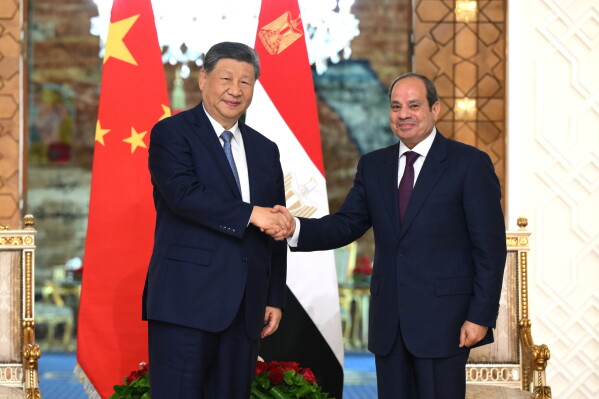
Xi met Egyptian President Abdel Fattah el-Sissi as China seeks to position itself as a stabilizing force in the Middle East, contrasting its approach with the United States’ decades-long military involvement in the region.
The visit comes against the backdrop of heightened regional tensions, including the six-month war involving the United States and Iran.
Analysts say Beijing has increasingly relied on economic partnerships, infrastructure investment and diplomacy to strengthen its standing across the Middle East.
Amr Hamzawy, director of the Carnegie Middle East Program, and former program fellow Kathryn Selfe argued in a paper earlier this year that China has continued to build its “soft power reserves” as Washington faces challenges to its influence.
Xi arrived in Cairo on Tuesday evening, where Egyptian and Chinese flags decorated the airport ahead of an official red-carpet welcome. President el-Sissi and Egyptian military guards greeted the Chinese leader on the tarmac.
During wide-ranging talks on Wednesday, Xi called on Beijing and Cairo to strengthen cooperation and jointly oppose what he described as “unilateralism and acts of bullying,” according to China’s state-run Xinhua news agency.
Xi also urged the two countries to work together toward what he called a “more just and equitable global governance system.”
The visit underscores China’s broader strategy of deepening relationships with influential Middle Eastern countries as Beijing seeks a greater role in regional diplomacy and global affairs.