U.S. District Judge Tanya S. Chutkan issued a temporary restraining order late Thursday, November 5, following an emergency request from the governments of Washington, D.C., and Virginia, effectively preventing the Trump administration from beginning construction for at least 14 days.
The ruling represents a significant setback for the president’s ambitious plan to erect a towering monument near Arlington National Cemetery, a proposal that has generated widespread opposition from military veterans, historians and members of the public.
The decision came shortly after the National Capital Planning Commission, which includes several Trump appointees, approved the project by an 8-4 vote following hours of public testimony.
Despite the commission’s approval, the legal challenges surrounding the monument remain unresolved.
Judge Chutkan also consolidated the lawsuit filed by the District of Columbia and Virginia with a separate legal challenge brought by three Vietnam War veterans and an architectural historian seeking to prevent construction.
Veterans Raise Concerns Over Arlington Cemetery
During the planning commission’s public hearing, opponents argued that the proposed monument would undermine the solemn atmosphere surrounding Arlington National Cemetery, one of America’s most significant military burial grounds.
Michael Lemmon, a Vietnam War veteran who served in the U.S. Army before pursuing a career in the foreign service, strongly criticized the proposal.
Lemmon, who is among those challenging the project in court, warned that the enormous structure would disrupt the peaceful and dignified environment traditionally associated with honoring America’s fallen service members.
He described the proposal as “frankly blasphemous,” arguing that the monument would be inappropriate for an area dedicated to remembering military sacrifice.
Lemmon was among approximately 130 individuals who registered to provide public comments before the commission voted on the project.
Critics also questioned whether the administration had obtained the necessary congressional authorization to construct such a prominent national monument.
Proposed Monument Would Tower Over Historic Landmarks
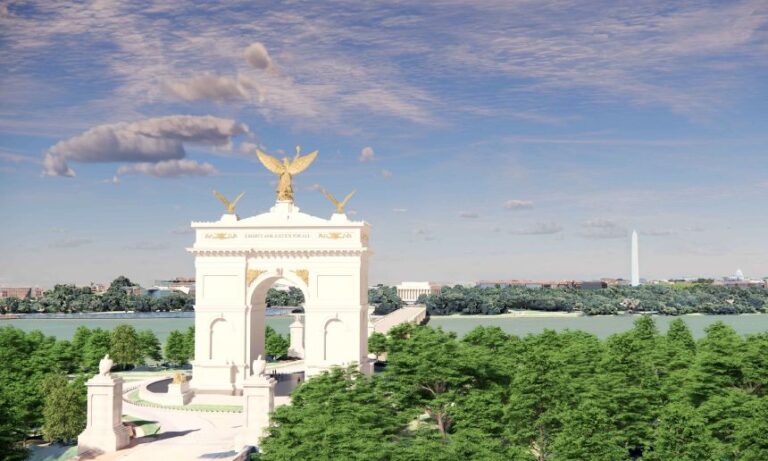
Standing at a proposed height of 250 feet, the triumphal arch would be more than twice as tall as the 99-foot Lincoln Memorial and would surpass the height of France’s famous Arc de Triomphe in Paris.
The structure is planned for Memorial Circle, near the entrance to Arlington National Cemetery, placing it within one of the country’s most historically significant commemorative landscapes.
Supporters of the project view the monument as an opportunity to celebrate American military service and national identity.
However, opponents argue that its enormous scale could overwhelm surrounding historic landmarks and permanently alter the character of the area.
The governments of Virginia and Washington, D.C., have also raised concerns about the potential consequences of construction, including traffic disruptions, public safety challenges and the impact on nearby infrastructure.
Legal Battle Threatens Construction Timeline
While the National Capital Planning Commission’s approval marked a major step forward for the administration, the federal court’s intervention has created fresh uncertainty over when, or whether, construction can proceed.
The temporary restraining order prevents the administration from beginning construction-related activities while the court considers the legal arguments presented by the opposing parties.
At the center of the dispute is whether the executive branch has sufficient legal authority to proceed with the project without specific approval from Congress.
The case highlights growing tensions surrounding the Trump administration’s plans to reshape prominent public spaces in the nation’s capital.
For now, construction remains suspended as the legal challenges continue, leaving the future of the proposed triumphal arch uncertain despite its approval by federal planning authorities.