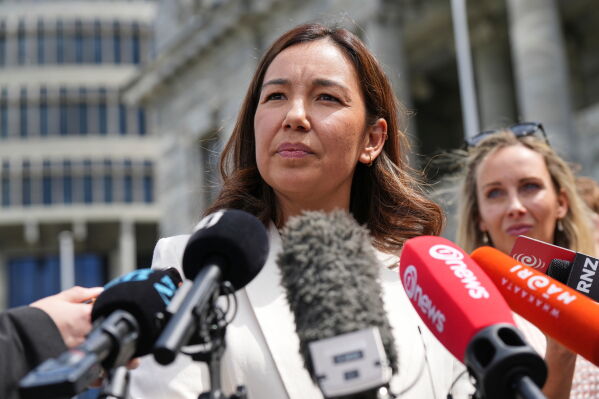
The official results, released Friday, November 27, by the Electoral Commission, have placed the newly elected centrist Opportunity Party in a decisive position, with its seven parliamentary seats potentially determining the composition of the country’s next government.
Prime Minister Christopher Luxon remains in a position to seek a second term, but his center-right National Party must now negotiate support from smaller political parties to secure the parliamentary majority required to govern.
The November 7 election was one of New Zealand’s closest contests in recent years, with the ruling conservative coalition initially appearing to have secured a narrow majority.
However, the counting of approximately 400,000 special votes, including ballots cast by New Zealanders living overseas, dramatically altered the parliamentary balance.
Luxon’s National Party lost two seats compared with the preliminary results, finishing with 40 seats in the 130-member Parliament.
Its traditional coalition partners, the ACT Party and New Zealand First, secured 13 and 12 seats respectively.
Together, the three parties hold 65 seats, leaving them just one seat short of the 66 required to command a parliamentary majority.
The opposition bloc, led by Labour Party leader Chris Hipkins, secured 58 seats, including 36 for Labour, 17 for the Green Party and five for Te Pāti Māori.
The results mean neither political bloc can govern independently, creating the need for negotiations with smaller parties.
The Opportunity Party, led by 38-year-old political newcomer Qiulae Wong, has emerged as a potentially decisive force after securing seven seats in its first successful entry into Parliament.
The centrist party has positioned itself as an alternative to New Zealand’s traditional political divisions, advocating evidence-based policies and greater cooperation across party lines.
Its success reflects growing voter dissatisfaction with the country’s two dominant political parties, National and Labour.
Wong has indicated a willingness to negotiate with political leaders from different ideological backgrounds, although the party has established clear policy priorities that potential coalition partners would need to consider.
These include stronger environmental protections, climate action and changes to political donation rules.
The party’s support would be sufficient to provide Luxon’s existing coalition with a parliamentary majority.
However, even with Opportunity’s seven seats, the left-wing opposition bloc would remain short of the 66 seats required to govern.
Although Luxon remains in a position to form the next government, negotiations could prove challenging because of significant policy differences among the parties whose support he requires.
Before the election, the prime minister had ruled out working with the Opportunity Party.
However, the final election results have created a political situation in which cooperation with the centrist group may be necessary to secure another term.
Luxon must also maintain the support of ACT and New Zealand First, whose positions on environmental protection, economic policy and other issues differ from some of Opportunity’s proposals.
The negotiations could involve difficult compromises as the parties attempt to establish a workable governing arrangement.
Opposition leader Chris Hipkins acknowledged Friday that Labour’s parliamentary numbers left it without a viable route to forming a majority government under the current party alignments.
Although Labour secured a larger share of the nationwide party vote than National, it won fewer parliamentary seats.
The result reflects the complexities of New Zealand’s mixed-member proportional electoral system, under which voters cast ballots for both political parties and local representatives.
The system allows smaller parties to gain parliamentary representation and can require coalition agreements when no single party wins an outright majority.
The election outcome has highlighted the increasing fragmentation of New Zealand’s political landscape, with voters distributing their support across a broader range of parties.
Economic concerns, including rising living costs and dissatisfaction with political leadership, featured prominently during the campaign.
Both National and Labour received less than 30 percent of the nationwide party vote, reflecting the challenges facing the country’s traditionally dominant political parties.
As negotiations begin, the Opportunity Party’s role could prove crucial in determining whether Luxon secures another term and what policy commitments his government will pursue.
If political leaders fail to reach an agreement capable of commanding parliamentary confidence, New Zealand could face a prolonged period of uncertainty and potentially another election.
For now, the final results have left the country without a confirmed governing majority, placing the future of New Zealand’s leadership in the hands of coalition negotiators and a newly elected centrist party.