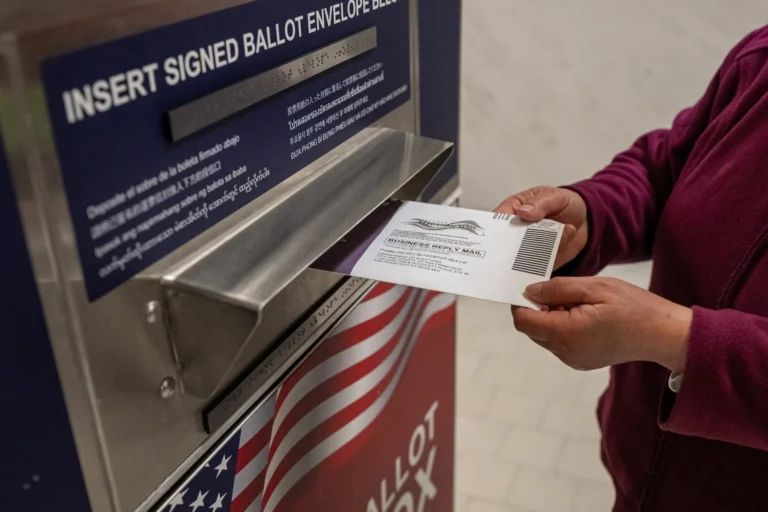
The United States Postal Service has issued new rules that would introduce additional verification requirements for mail-in ballots, though the measures cannot take effect unless a federal court lifts an existing injunction.
USPS said it is prepared to implement the changes immediately if the legal restriction is removed.
Under the new system, states would be required to provide basic voter information, including a voter’s name and residential address, and link those details to a unique barcode assigned to each mail-in ballot.
State election authorities would also have to enter the information into a federal ballot-mail portal before ballots could be accepted into the postal system.
USPS said ballots from states that fail to comply with the requirements would not be delivered.
The changes follow months of efforts by the Trump administration to expand access to voter information as part of its election-integrity agenda. Critics have raised concerns that concentrating voter information at the federal level could interfere with the traditional role of states in administering elections.
Jonathan Diaz, director of voting advocacy at the bipartisan Campaign Legal Center, warned that federal control over voter qualification procedures could give an administration significant influence over the electorate.
The USPS requirements are narrower than measures President Donald Trump sought in a March executive order. That order called for statewide citizenship-verification lists using Social Security or immigration databases, standardized ballots and greater coordination between USPS, its inspector general and the Justice Department over suspected illegal use of the mail involving federal election materials.
While elements of those proposals appear in the final USPS rule, the postal service said the system would collect only limited information and would not include voters’ birth dates, Social Security numbers or other registration details.
USPS also emphasized that it would have no role in determining whether individuals are eligible to vote, maintaining voter registration lists or counting ballots.
Implementation of the new requirements now depends on the outcome of the ongoing court proceedings.