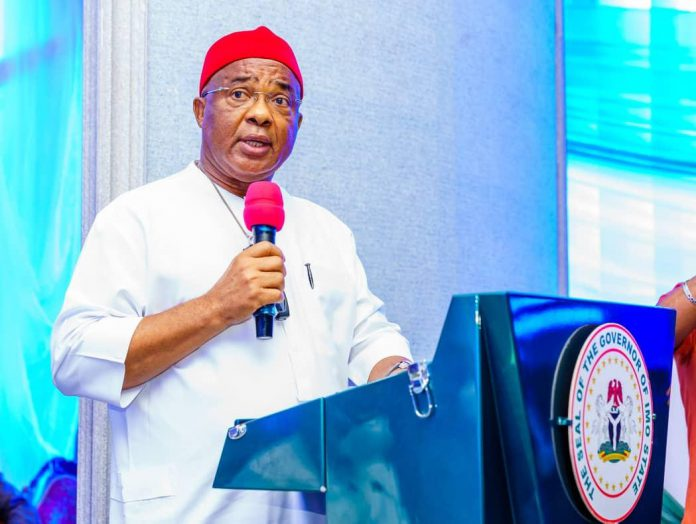
The Imo State Government has begun payment of the newly approved ₦104,000 minimum wage to state workers, fulfilling Governor Hope Uzodimma’s earlier promise to improve workers’ welfare.
Several civil servants who received payment alerts over the weekend expressed gratitude to the governor, describing the wage increase as a morale booster and a sign of the administration’s commitment to the workforce.
Governor Uzodimma had recently approved ₦104,000 as the new minimum wage for fresh government employees, ₦513,000 for medical doctors, and ₦220,000 as the entry-level salary for lecturers in state-owned tertiary institutions.
With this development, Imo State now leads other states in implementing the new national minimum wage benchmark of ₦70,000 ahead of Lagos (₦88,000), Rivers (₦85,000), and Akwa Ibom and Bayelsa (₦80,000 each).
In a statement on Sunday, the governor’s Special Adviser on Public Enlightenment, Eze Ugochukwu, said the wage increase would have a positive impact on the state’s economy.
“Governor Hope Uzodimma’s administration is spearheading this significant policy change, which will greatly influence the economic and social well-being of the state. The increased spending power of workers will stimulate economic activities and uplift the local economy,” he said.
Meanwhile, the Imo State Government has announced plans to shut down all illegal private primary and secondary schools across its 27 local government areas.
According to a statement by the Commissioner for Primary and Secondary Education, Prof. Bernard Ikegwuoha, any school operating without valid approval or reopening after being previously sealed without authorization will be closed and its proprietors arrested.
“Monitoring and closure of illegal schools or those operating with expired approval letters will soon commence across the state,” the statement read.
In a related development, Anambra State Governor, Prof. Charles Soludo, has approved the 100 percent implementation of the Consolidated Health Salary Structure (CONHESS) for all health workers in the state, with immediate effect.
A statement by the Head of Service, Theodora Igwebe, directed all relevant Ministries, Departments, and Agencies (MDAs), including the Local Government Service Commission, to begin full implementation without delay.
The directive covers all health professionals, including nurses, psychiatric nurses, anesthetists, community health workers, medical laboratory scientists, radiographers, and physiotherapists. The state and local government accountants-general were also instructed to ensure compliance.