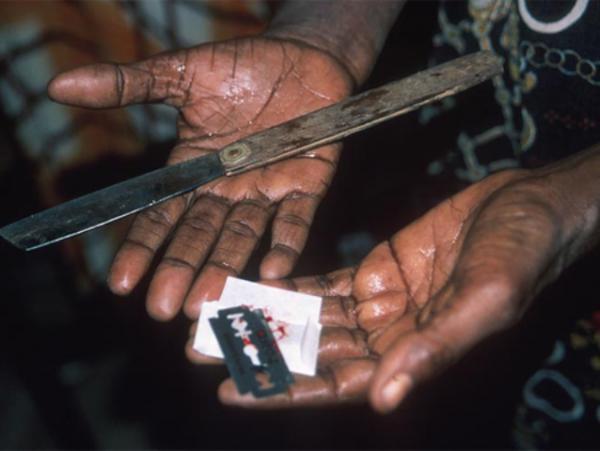
Such practitioners will lose their operational licenses and face a two-year prison sentence.
If proven guilty, local and unorthodox practitioners of the dangerous practice could face two years in jail and a fine of N200,000.
The Ekiti State Gender-Based Violence (GBV) Provision Law was passed in 2019 as an extreme step to address an ancient practice.
Despite the law and enlightenment programs, the state administration continues to face resistance from traditionalists.
Olukemi Akinleye, the Coordinator of Ekiti State programme on the Eradication of FGM, said on Saturday that the state government is now going hard on those involved.
She spoke at a workshop organised by Hacey Health Initiative, held in Iyin-Ekiti, Irepodun/ Ifelodun Local Government Area of Ekiti State.
Mrs Akinleye appealed to Ekiti residents to collaborate with the government for increased awareness to stamp out FGM that had brought shame to the state.
“The Anti-FGM Law had been in existence since 2002, but was in 2019 integrated into the GBV Prohibition Law,” she said.
“The government is now more severe about the implementation and those still practising the harmful custom will be punished .
“In the law, any medical staff found culpable of cutting female genitalia, is to forfeit his license and go to two years imprisonment with an option of N200,000 fine.
Ekiti is topping the chart of states still practising FGM in the South-west, with an index of 57.9 per cent, according to the World Health Organisation.
“Ekiti State is a honourable state, land of honour and can’t be found to be leading in FGM and having the highest teenage pregnancy indices in the Southwest” said Ms Akinleye.
“This is largely due to lack of sex education and this is what we are trying to correct.
“A lot of homes had been disorganised as a result of long-term infections from FGM causing barrenness, marital crisis and increased domestic violence. Our people must stop this at all cost.”
She disregarded as baseless the notions that women who did not have their genitals cut would be promiscuous and have stillbirths, claiming that the opposite was true.
Bamidele Oyewumi, a spokesperson of Hacey Health Initiative, said the organization is committed to working with the state government to sensitize citizens about the dangers of FGM in order to protect citizens’ lives.
Ekiti had a prevalence incidence of 72 percent in 2013, but it has declined to 57.9% in 2019. The figure, on the other hand, has not enhanced its position, since it has already surpassed Osun State, which had previously held the top slot.
According to UNICEF, five Nigerian states are at the forefront of female genital mutilation: Ebonyi, Ekiti, Imo, Osun, and Oyo.
In a report, UNICEF estimated that approximately three million girls and women had been subjected to female genital mutilation in the last five states.
According to UNICEF, the prevalence of FGM is highest in the South-east, with 35%, followed by the South-west with 30%, and the North-east with 6%.
According to the Fund, female genital mutilation is still prevalent in Nigeria, with an estimated 19.9 million survivors.