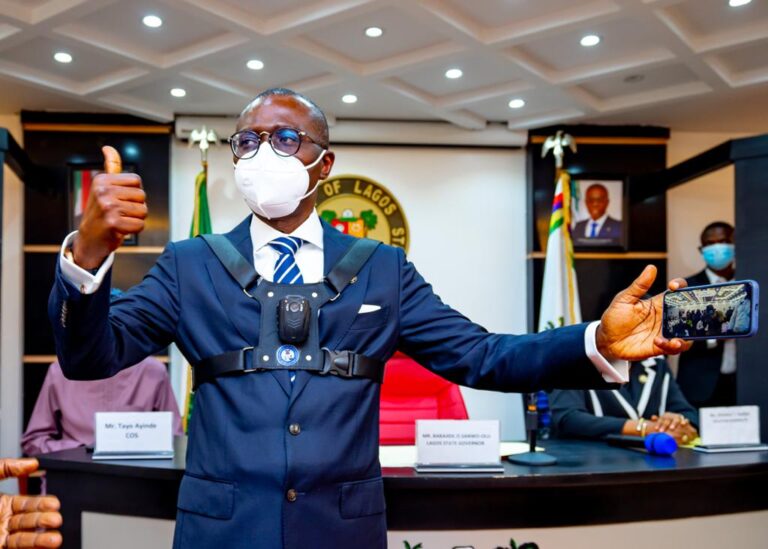
The state governor, Babajide Sanwo-Olu, launched the use of body-worn cameras by officers on March 31 as part of the Lagos State Government’s attempts to increase the professionalism and accountability of law enforcement officials.
According to the governor, the cameras were the first of their kind in the state and were intended to put the state in a better position to respond to security concerns while also curbing security agents’ overbearing behavior.
“The security challenges in different parts of the country are worrisome, but with proactive action, the use of modern technological tools, and a mix of well-trained and intelligent officers, we will successfully combat many of these challenges,” Mr. Sanwo-Olu said.
“With body-worn cameras, our law enforcement officers are better equipped to protect lives and properties, thereby, making Lagos safer for us all.”
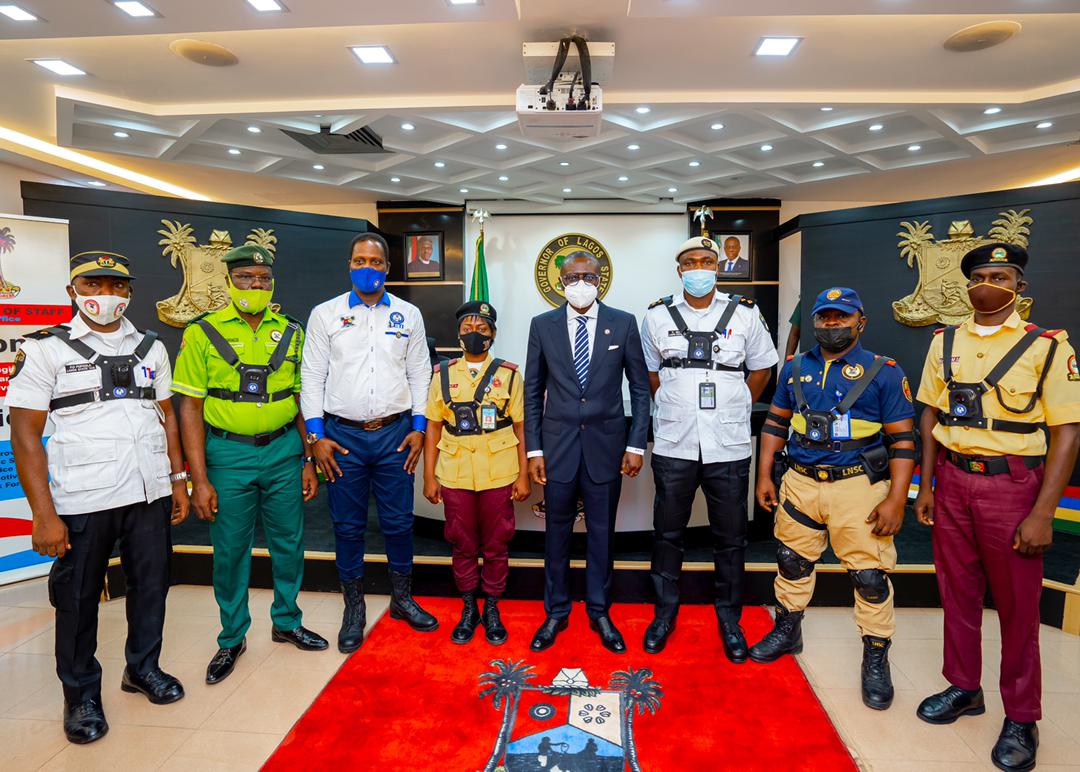
The governor stated during the unveiling that state-funded security officers such as the Lagos State Traffic Management Authority (LASTMA), Vehicle Inspection Service (VIS), Lagos Neighborhood Safety Corps (LNSC), and the Lagos Environmental Sanitation Corps (LAGESC) would employ the body-worn cameras.
The Lagos State Law Enforcement Training Institute (LETI) was to teach 7,000 officers in 26 batches how to operate the cameras as part of the scheme.
LETI was founded in 2013 through Executive Order to provide standards for the recruitment, training, and development of law enforcement officers.
Unveiled but unimplemented
Although people, security professionals, and human rights organizations applauded the introduction of digital gadgets, they have mainly gone unused in the state.
In October, this reporter traveled around Lagos to investigate how widely the digital tools had been deployed and how they were being used, but not a single officer was wearing body cameras. All of the officers who were interviewed confirmed that they had not been handed the body cams.
‘No cameras were provided’ – Officers
Despite the Sanwo-Olu administration’s “strong resolve” to modernize the state’s security apparatus, no law enforcement official has been seen using the digital camera launched in March.
PREMIUM TIMES watched law enforcement officials from Mile 2 to Ojota, Oshodi, Berger, Lekki, Agege, and Surulere; none were wearing body cameras.
A LASTMA official in the Ojota area told PREMIUM TIMES that he was aware of a batch of training for chosen officers in the state, but that nothing had been done afterward.
“They said they will still train more of us, so, many are waiting to be shortlisted for the training. Without the training, you cannot use the camera and even many of those who have been trained are yet to be given cameras,” he said.
The official, who did now want to be named because he was not authorized to speak to this reporter, said the training is hierarchical as the digital gadget cannot be given to all officials.
An LNSC official, who identified himself as Adeleke, said they are yet to be given cameras though they had been informed of their introduction.
“Those of us that patrol and work on the road in different local governments have not been given any camera. I am not sure you will find any officer on this Lagos road wearing a camera,” he said.

Another LASTMA officer said he got to know about the introduction of the body camera when it was launched by the state governor, but there has been “silence” by the authority on how officers can access them.
Efforts to speak to the General Manager of LASTMA, Bolaji Oreagba, over the body-worn cameras were unsuccessful. He did not respond to calls and text messages. He was also not in the office when this reporter visited.
Olumide Filade, the spokesperson of LASTMA, also did not reply to calls and text messages as of the time of filing this report.
As of October 30, most law enforcement officers in different parts of Lagos were yet to begin the use of body cameras.
There have been several reports of high-handedness of law enforcement officers in Lagos, which includes the extortion of motorists by LASTMA officers and other unprofessional conduct.
With the introduction of body-worn cameras by offices, the Lagos State government hopes to improve security and cut down unprofessional conduct by officers. The use of the cameras will also offer protection to officers by providing real-time evidence.
Introduction of body cameras, a positive step – Experts
Experts say the use of body cameras will give the state a higher advantage in crime management and also boost its smart city prospects.
Yusuf Anas, a security analyst, and retired air commodore said the initiative is a positive step on the part of the state government and deserves commendation. Mr. Anas is the Executive Secretary of the Centre for Crisis Communication.
“It is in line with global best practices, it will assist the government and the law enforcement officers to track what suspects are up to. The cameras can also be used as exhibits in court because the camera will show precisely the events that happened,” he said.
Mr. Anas said records from the cameras can be put in the database of law enforcement agencies, which could help them match a suspect’s crime in one scene to another crime in another scene.
“It will also serve as a check on security agencies because if they try to maltreat suspects or frame suspects, it will show clearly that they are the ones that are at fault or trying to induce a crime on an innocent citizen.
“Lagos is a center of excellence, if they are the first to introduce this, it will also encourage other states to introduce it to curb crime and check the excesses of the security agencies,” Mr. Anas said.
Cameras used by the ‘elite squad’
PREMIUM TIMES spoke with Falade Oyekan, the former Director-General of LETI, about the state’s use of body cameras.
The cameras are already being utilized by an ‘elite squad,’ according to Mr. Oyekan, who is now the General Manager of the Lagos State Neighborhood Safety Agency (LNSA).
The officers are assigned to special events attended by the governor and other state officials, as well as occasions with dignitaries in attendance, according to him. He stated that the cameras are used for security purposes.
The government has purchased body cams, according to Mr. Oyekan, but they can’t be given to officers right away because they have to follow a ‘systematic pattern.’
“If you deploy at once, you can’t get it right. If we deploy stage by stage, once there is something that we found is not right, we can improve when deploying to others. If done en masse, we can’t get it right.
“Law enforcement officers have lost their integrity and it is for us to help them bring that back. With the use of body-worn cameras, we can check the officers as well as the motorists and citizens,” he said.
The LNSA boss added that to actualize the body-worn cameras initiative, law enforcement officers need to undergo training on the proper use of the cameras, which will also take some time.
“We went to six foreign countries to get different samples of body-worn cameras for officers to get the perfect one.”
Mr. Oyekan said the government is also trying to set up a control room where all the cameras in circulation will be connected and would enhance live tracking of activities of law enforcement officers in different parts of the state.
“The cameras are available but it is for us to follow the due process. First, they need to be trained thoroughly and not all the officers will wear the cameras,” he said.
Also, the Chief Press Secretary to Mr. Sanwo-Olu, Gboyega Akosile, said plans are ongoing for the circulation of the cameras.
“The process is ongoing, the governor launched it and that is to tell you that it was well-thought and the process was on. We have the cameras but they needed to train the personnel that will be wearing the cameras.
“It is not only about the camera, the governor keeps talking about smart Lagos where there will be a well-integrated security network, things will be monitored from the command and control center,” he said.
Mr. Akosile said the body-worn cameras will be built on the backbone of the fiber optic cables that are being laid across the state.
“Have they started wearing body cameras? Yes, they have started wearing it. Now, are they everywhere? The answer is no, they are not everywhere just yet?
“You can be rest assured that they will spread. For the governor to have thought about it in the first place simply means we have the plans to secure people in a digital way using technology,” the governor’s spokesperson said.
Ada Peter