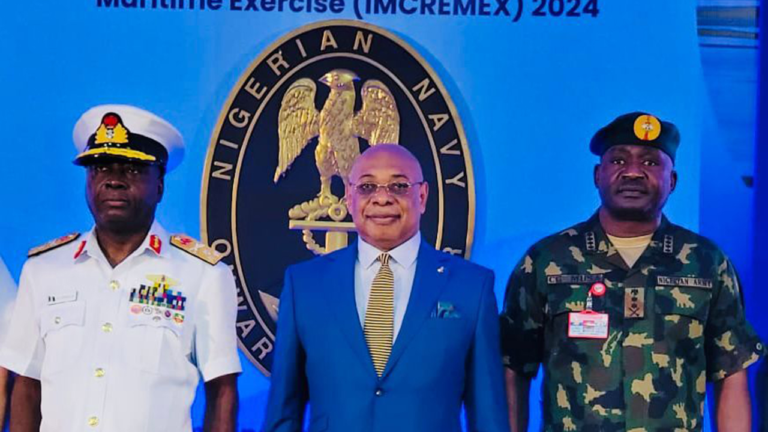
The Minister of State for Defence, Bello Matawalle, has urged African naval forces to deepen regional collaboration in response to escalating maritime insecurity, stressing that no nation can effectively confront the threats in isolation.
He made the call at the opening ceremony of the 2026 Sea Power for Africa Symposium themed “Leveraging Technology for Enhanced Maritime Security in Africa,” hosted by the Nigerian Navy and its partners as part of activities marking its 70th anniversary.
Addressing over 30 Chiefs of Naval Staff, heads of navies and coastguards, maritime experts, and global industry stakeholders, Matawalle noted that the scale and complexity of maritime crimes have outgrown the capacity of individual countries.
“The transnational and interconnected nature of maritime threats presents formidable challenges which often transcend the capacity of individual nations or navies to address independently,” Matawalle said.
He emphasised the urgency of stronger regional alliances and the adoption of advanced technologies in securing Africa’s maritime domain, highlighting tools such as unmanned systems, AI-powered surveillance, and improved data-sharing networks.
“As the Blue Economy moves to the forefront of Africa’s developmental agenda, our maritime forces must evolve from traditional coastal defense to active facilitators of economic security,” he stated.
“This forum serves as a catalyst for integrating cutting-edge technologies including unmanned systems, AI-driven surveillance, and enhanced data-sharing networks into our operational architecture.”
Matawalle further stressed that the goal is to build “a secure, transparent, and predictable maritime environment” that supports economic growth and regional prosperity.
He also reaffirmed the Federal Government’s commitment to modernising and strengthening the Nigerian Navy, noting that national readiness and regional cooperation must advance together.
Speaking at the event, the Chief of Naval Staff, Idi Abbas, described the symposium first launched in 2004 as a key platform for advancing maritime security cooperation across Africa.
He said the 2026 edition is especially significant as African nations increasingly prioritise the Blue Economy as a driver of development.
Abbas warned that maritime threats remain highly complex and cross-border in nature, requiring closer coordination among navies and maritime law enforcement agencies.
He referenced the African Integrated Maritime Strategy 2050 and the African Charter on Maritime Security as key frameworks guiding continental collaboration.
While welcoming technological advancements in maritime operations, he cautioned that criminal networks and non-state actors could also exploit these innovations for illicit purposes.
“Advanced technologies can be subverted by non-state actors who may exploit them for illegal purposes and criminal enterprises, even within our maritime domains,” he warned.
Abbas urged participants to focus on developing practical strategies that strengthen security while preventing misuse of emerging technologies.
The symposium is expected to produce recommendations aligned with the United Nations Sustainable Development Goal 14 and the African Union’s Agenda 2063.