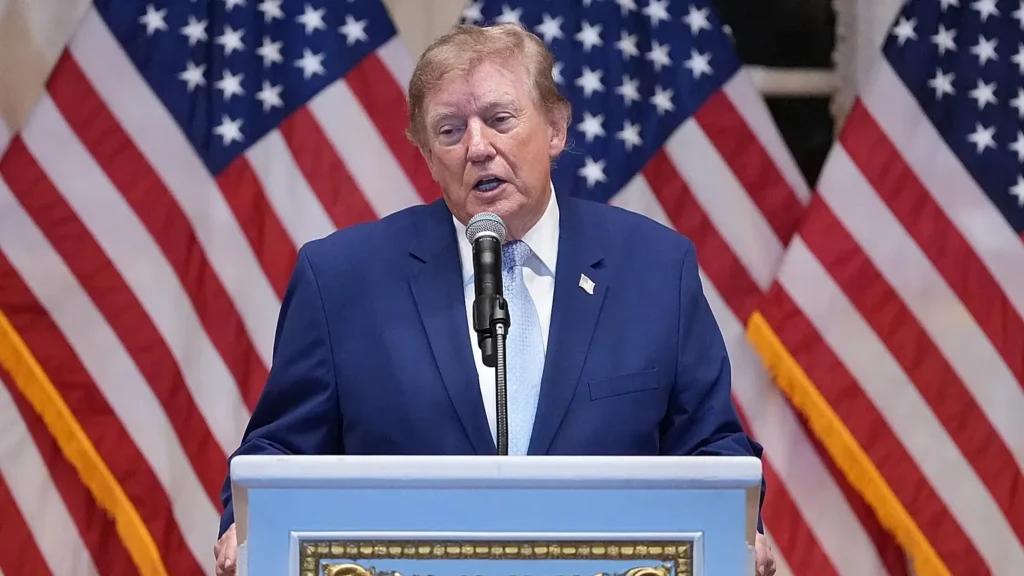
President Donald Trump has announced the removal of Federal Reserve Governor Lisa Cook, citing what he claims are false statements related to mortgage documentation. The move has sparked a constitutional controversy, with Cook rejecting the decision and vowing to remain in office.
Trump asserted that he had “sufficient reason” to terminate Cook under executive authority, referencing discrepancies between mortgage filings in Michigan and Georgia. He made the announcement through a formal letter posted on his social media platform.
Cook swiftly rejected the president’s action, calling it unlawful. “President Trump purported to fire me ‘for cause’ when no cause exists under the law, and he has no authority to do so,” she said. “I will not resign.”
Her legal counsel, Abbe David Lowell, confirmed they will challenge the decision through legal channels. “We will take whatever actions are needed to prevent this attempted illegal action,” he said.
This unprecedented attempt to remove a sitting Federal Reserve governor—an independent agency board member—could lead to a major legal battle. Cook, appointed by President Joe Biden in 2022, is the first Black woman to serve on the Fed’s Board of Governors and is a voting member of the Federal Open Market Committee, which sets national interest rate policy.
The controversy stems from a complaint by housing policy figure Bill Pulte, who alleged inconsistencies in Cook’s mortgage filings and submitted a referral to Attorney General Pam Bondi. Trump cited the matter as justification for Cook’s dismissal. Cook has previously stated that the issue dates back to a mortgage application filed before she joined the Fed and said she is reviewing the matter to provide clarity.
Legal scholars note that Federal Reserve governors are typically appointed for 14-year terms and can only be removed “for cause,” a standard that historically requires congressional or judicial oversight—not unilateral presidential action.
The Federal Reserve has not yet issued a public statement in response to the president’s move. The situation has raised concerns about the erosion of central bank independence, a cornerstone of U.S. economic policy since the Fed gained autonomy from the executive branch in 1951.
President Trump has frequently criticized the central bank and its chairman, Jerome Powell, for not cutting interest rates fast enough. Although Powell recently hinted at a potential rate cut in September, Trump has continued to pressure the Fed to act more aggressively.
The standoff now sets the stage for a constitutional test of the limits of executive power over independent financial institutions.