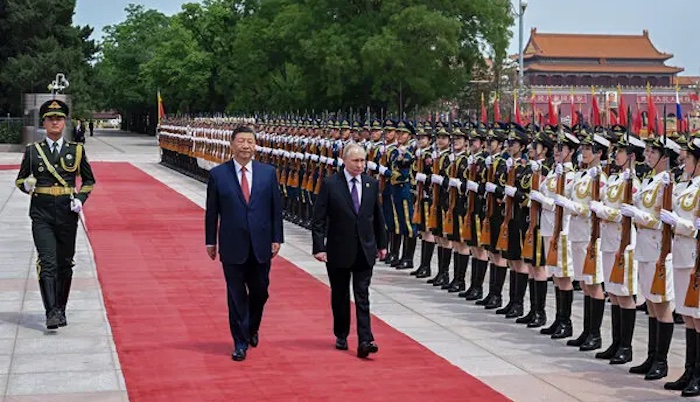
Russian President Vladimir Putin and North Korean leader Kim Jong Un are expected to stand alongside Chinese President Xi Jinping at a high-profile military parade in Beijing next week, in what will be their first public appearance together. The event, scheduled for September 3, commemorates the 80th anniversary of Japan’s World War II surrender and is seen as a symbolic display of solidarity amid intensifying pressure from Western powers.
China’s foreign ministry confirmed that leaders from 26 countries will attend the “Victory Day” ceremony, though participation from Western nations is notably absent—with Slovakia’s Prime Minister Robert Fico being the only EU leader currently expected.
The gathering highlights China’s growing military assertiveness and its strengthening ties with Russia and North Korea, two nations increasingly cut off from the global community. For President Putin, the visit marks his first trip to China since 2024 and comes amid ongoing international sanctions over Russia’s war in Ukraine. North Korea, meanwhile, remains under strict UN sanctions for its nuclear and missile programs.
Joining the lineup of international attendees are Belarusian President Aleksandr Lukashenko, Iranian President Masoud Pezashkian, Indonesian President Prabowo Subianto, Serbian President Aleksandar Vucic, and South Korean National Assembly Speaker Woo Won-shik. The United Nations will be represented by Under-Secretary-General Li Junhua.
The grand parade, to be held at Tiananmen Square, will feature large-scale military displays including hypersonic missiles, missile defense systems, and next-generation fighter jets. President Xi will oversee the review of troops and hardware, reinforcing China’s position as a central force in global military dynamics.
Analysts interpret the event as a powerful statement of alignment among China, Russia, and North Korea, while also signaling Beijing’s outreach to other nations in the Global South. The display comes at a time of rising strategic competition between China and the West, and is expected to underscore an emerging bloc of nations challenging the existing international order.