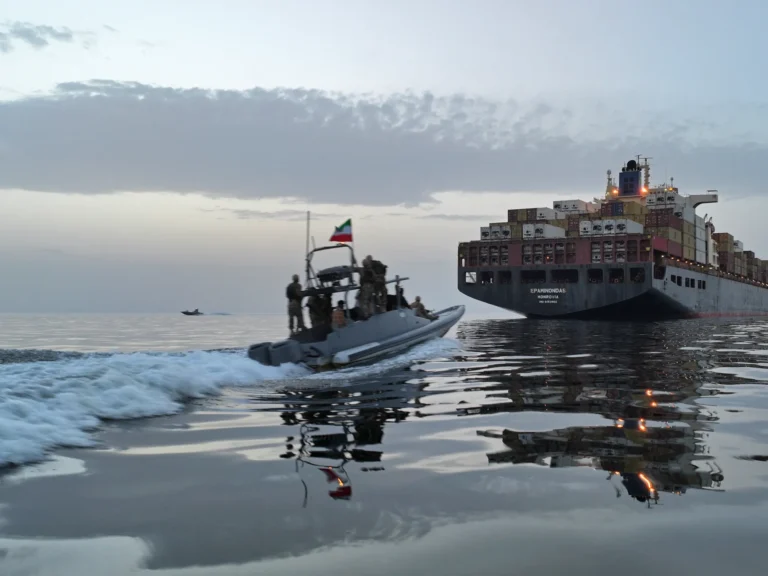
The reported incidents occurred Thursday amid continuing hostilities involving Iran and the United States, as diplomatic efforts to resolve the conflict remain uncertain.
A British maritime security agency reported that a vessel was burning in the Strait of Hormuz, although the condition and whereabouts of its crew were not immediately known.
Shortly afterward, Iran’s Islamic Revolutionary Guard Corps, or IRGC, claimed that three oil tankers had exploded after striking sea mines while attempting to navigate a shipping route that Tehran considers unauthorized.
The Iranian claims have not been independently verified, and it remains unclear whether the burning vessel reported by British authorities was among the three tankers identified by the IRGC.
In a statement issued Thursday, the IRGC Navy’s public relations office said the incidents occurred over the preceding 24 hours.
According to the statement, the three tankers were attempting to pass through the southern section of the Strait of Hormuz when they encountered naval mines.
Iranian authorities said the vessels caught fire following the explosions and were subsequently stranded along the southern shores of the waterway.
The IRGC accused the ships of disregarding repeated warnings about the dangers of using the route.
“These oil tankers had switched off all their radar and navigation systems,” the IRGC said.
Iranian officials claimed the vessels had disabled their navigation equipment while attempting to avoid maritime restrictions imposed by opposing forces in the region.
The IRGC further alleged that the ships ignored instructions from Iranian naval authorities before entering the disputed passage.
The force said it considered the vessels’ owners and crews responsible for choosing a route Tehran had repeatedly warned against.
The incidents highlight an escalating disagreement between Washington and Tehran over the movement of commercial vessels through the Strait of Hormuz.
The narrow waterway is one of the world’s most strategically important shipping corridors, connecting the Persian Gulf with international maritime routes.
The United States has encouraged commercial shipping operators to use a southern passage through the strait.
President Donald Trump previously declared that route free of naval mines at the end of August.
Iran, however, maintains that vessels should transit the waterway only through routes administered by Iranian authorities, closer to the country’s northern coastline.
Tehran has insisted that ships coordinate their movements with Iranian officials before entering those designated passages.
The conflicting instructions have created uncertainty for shipping companies attempting to navigate the region amid military tensions and maritime restrictions.
Thursday’s reported explosions raise new questions about the safety of the southern route and the reliability of previous assurances that it was free of mines.
In a separate development, U.S. Defense Secretary Pete Hegseth has reportedly dismissed Lieutenant General Brett Sylvia, the Pentagon’s top military planner.
A Pentagon official told CBS News that Sylvia was removed after being accused of leaking classified information related to the war involving Iran.
The report did not establish the specific information allegedly disclosed or provide details about the evidence supporting the accusation.
The reported dismissal comes during a sensitive period for U.S. military operations in the Middle East.
It also adds to concerns surrounding the handling of classified military information as Washington continues to manage the conflict and its regional consequences.
Despite the escalating military tensions, Iran’s foreign minister indicated Wednesday that Tehran remains open to diplomatic efforts aimed at resolving the conflict.
The minister said Iran “continues to give diplomacy a chance to succeed.”
The statement followed a Reuters report that Tehran had rejected a new peace proposal presented by Qatari mediators.
The reported rejection suggests that significant disagreements remain between the parties, even as regional intermediaries attempt to facilitate negotiations.
Qatar has played a mediating role in several Middle Eastern diplomatic disputes, and its involvement reflects continuing efforts to find a negotiated solution.
However, the details of the latest proposal and the specific reasons for Iran’s reported rejection were not disclosed in the information provided.
The reported tanker explosions have renewed concerns about the vulnerability of commercial shipping in the Strait of Hormuz.
Any sustained disruption to traffic through the waterway could affect international energy markets, shipping costs and the movement of oil from Gulf producers.
The immediate priority for maritime authorities is determining the status of the affected vessels and their crews, particularly the ship reported burning by the British maritime agency.
The extent of the damage and the environmental consequences of the reported incidents also remain unclear.
As the United States and Iran continue to dispute control over shipping routes, commercial operators face difficult decisions about navigating the waterway safely.
Thursday’s developments underscore the fragile security situation in the region, where military confrontation, maritime hazards and uncertain diplomatic negotiations continue to threaten stability.
For now, the condition of the affected crews, the precise circumstances of the reported explosions and the prospects for renewed peace talks remain unresolved.