Taiwan’s Deputy Foreign Minister Chen Ming-chi issued the warning on Saturday during an interview with The Associated Press at the Halifax International Security Forum in Nova Scotia, Canada.
Chen expressed concern over Carney’s recent efforts to improve diplomatic and trade relations with Beijing, cautioning that Taiwan’s own experiences demonstrated the risks of becoming economically dependent on China.
The Taiwanese official acknowledged Carney’s concerns about powerful nations using trade relationships as instruments of political influence but questioned whether closer economic cooperation with Beijing would undermine Canada’s efforts to protect itself from such pressures.
Taiwan Questions Canada’s Trade Strategy
Carney has repeatedly warned that major global powers are increasingly using economic relationships to advance their political and strategic interests.
During his address at the World Economic Forum in Davos, Switzerland, the Canadian prime minister criticized the use of tariffs, trade restrictions and control over critical resources as tools of economic coercion.
He also encouraged middle powers to diversify their international partnerships to reduce their vulnerability to pressure from larger economies.
However, Chen questioned whether Canada’s renewed engagement with China was consistent with that position.
While praising Carney’s remarks in Davos, he urged Ottawa to carefully consider the political values and reliability of potential trading partners.
Past Detention of Canadians Raises Concerns
Chen also pointed to the detention of two Canadian citizens in China as a reminder of the diplomatic risks associated with relations between Ottawa and Beijing.
Former Canadian diplomat Michael Kovrig and businessman Michael Spavor were detained by Chinese authorities in December 2018, shortly after Canada arrested Huawei executive Meng Wanzhou at the request of the United States.
Their detention lasted nearly three years and prompted accusations that Beijing was using the two Canadians as bargaining tools in a diplomatic dispute.
Both men were released in September 2021, the same day Meng returned to China.
Chinese authorities have consistently denied that the detentions were politically motivated.
Chen suggested that the episode should serve as a warning to Canadian policymakers about the potential consequences of becoming overly reliant on Beijing.
Carney Seeks New Trade Opportunities Amid US Tariff Threats
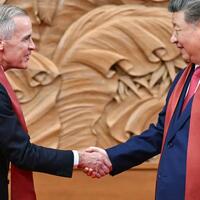
The warning comes just days after Carney met Chinese President Xi Jinping in Shenzhen, where the two leaders agreed to additional tariff reductions as Canada seeks to diversify its international trade relationships.
Ottawa’s renewed engagement with Beijing comes amid growing economic tensions with Washington under US President Donald Trump.
Trump has threatened to impose tariffs of up to 50 percent on Canadian vehicles and automobile parts beginning January 1, raising fears of significant disruption to Canada’s automotive industry.
Carney has suggested that Canada could consider partnerships with Chinese automobile manufacturers if negotiations with the United States fail to secure the future of its domestic automotive sector.
The proposal reflects Canada’s efforts to identify alternative markets and investment opportunities as uncertainty grows over its longstanding economic relationship with Washington.
Chinese Electric Vehicles Raise Security Questions
Chen warned that expanding cooperation with Chinese electric vehicle manufacturers could create new challenges for Canada’s industrial sector and national security.
He argued that increased competition from Chinese automakers could weaken domestic manufacturers and threaten Canadian jobs.
The Taiwanese official also raised concerns about the advanced communication and data-collection technologies installed in modern electric vehicles.
According to Chen, connected vehicle systems could potentially create surveillance and data-security vulnerabilities, even when the vehicles are manufactured within Canada.
His remarks highlight broader concerns about the security implications of allowing foreign technology companies to play an increasingly influential role in critical industries.
Canada Faces Difficult Economic Balancing Act
The dispute underscores the challenges facing Canada as it attempts to diversify its international trade relationships while protecting its economic and national security interests.
For Carney, strengthening economic cooperation with China could help reduce Canada’s dependence on the United States at a time of growing uncertainty over American trade policies.
However, Taiwan argues that replacing one form of economic dependence with another could expose Canada to similar pressures in the future.
As Ottawa continues discussions with Beijing, Chen’s warning adds another dimension to the debate over how Canada should balance economic opportunities, democratic values and national security.
The developing relationship between Canada and China is likely to remain under close scrutiny as both countries seek to expand cooperation amid growing geopolitical and economic tensions.