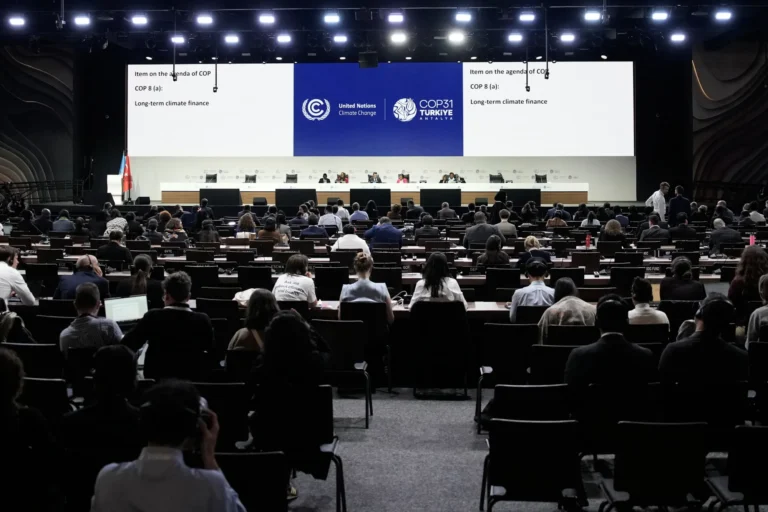
The breakdown on Sunday, November 22, followed more than two weeks of negotiations aimed at strengthening global efforts to combat climate change, reduce greenhouse gas emissions and increase financial assistance for vulnerable countries.
The summit, originally scheduled to conclude Friday, extended into a second day of overtime as negotiators struggled to overcome disagreements surrounding coal, oil and natural gas, the leading contributors to global warming.
Despite last-minute diplomatic efforts by the summit’s Turkish and Australian leadership, the final proposal failed to secure the near-unanimous support required for adoption.
At the center of the dispute was the omission of explicit language calling for a transition away from fossil fuels.
The proposed agreement, presented by Turkish Environment Minister and COP31 President Murat Kurum, did not directly mention coal, oil or natural gas.
Instead, the draft referred to previous international climate agreements, including commitments made at the COP28 summit in Dubai to transition away from fossil fuels.
Several countries argued that the wording was inadequate and represented a retreat from earlier climate commitments.
The European Union maintained that any credible global climate agreement must acknowledge the primary causes of global warming and establish a stronger foundation for reducing emissions.
The disagreement ultimately prevented the proposed document from receiving the support necessary for formal adoption.
European representatives strongly criticized the final draft, arguing that it failed to reflect scientific evidence or the urgency of the climate crisis.
Ireland’s Environment Minister Darragh O’Brien said the European Union could not support an agreement that failed to confront the widening gap between existing climate commitments and the action required to limit global warming.
Other European countries also expressed concerns that the proposed language would weaken international efforts to reduce fossil fuel dependence.
The rejection dealt a major blow to the summit’s leadership, which had sought to balance demands for stronger climate action with opposition from countries whose economies depend heavily on fossil fuel production.
Panama also opposed the proposed agreement, demanding more ambitious measures to limit oil production and provide financial assistance to countries suffering the consequences of climate change.
Panamanian Environment Minister Juan Carlos Navarro had previously accused powerful petroleum interests of obstructing meaningful climate negotiations.
He called for stronger commitments to reduce emissions, acknowledge the failure to meet global temperature targets and increase funding for climate adaptation.
Other vulnerable nations shared concerns that the proposed agreement failed to provide sufficient protection for communities facing rising sea levels, destructive storms, extreme heat and worsening droughts.
Many developing countries argued that wealthy nations must provide greater financial assistance to help them protect infrastructure, strengthen disaster preparedness and recover from climate-related losses.
Another major point of disagreement involved the draft’s support for technologies designed to capture and store carbon dioxide emissions.
Oil-producing countries have supported the use of carbon capture technology as part of global efforts to limit warming.
However, environmental organizations warned that placing too much emphasis on the technology could allow continued fossil fuel production while delaying investment in renewable energy and direct emissions reductions.
Critics also raised concerns about the technology’s cost and its limited deployment at the scale needed to address global emissions.
The failure to approve a final political agreement represents a significant setback for international efforts to accelerate climate action.
COP31 President Murat Kurum had urged participating governments to find common ground, arguing that a compromise remained possible despite the divisions.
However, the opposition proved too strong, leaving the summit without the broad political declaration negotiators had spent more than two weeks attempting to secure.
The breakdown does not cancel commitments already established under the Paris Climate Agreement or previous United Nations climate conferences.
Nevertheless, it raises questions about the ability of the international community to reach stronger agreements as global temperatures continue to rise.
The unsuccessful negotiations come amid growing warnings that the world is on course to exceed the Paris Agreement’s target of limiting global warming to 1.5 degrees Celsius above pre-industrial levels.
Scientists have cautioned that further temperature increases could intensify extreme weather events, accelerate sea-level rise and threaten food security, infrastructure and livelihoods.
For vulnerable countries already suffering from climate-related disasters, the failure to secure stronger financial and emissions-reduction commitments represents a particularly troubling development.
The outcome also highlights the persistent divide between countries demanding a faster transition away from fossil fuels and those seeking to protect their oil- and gas-dependent economies.
With the next United Nations climate summit scheduled for Addis Ababa, Ethiopia, in November 2027, pressure is expected to intensify on governments to rebuild diplomatic momentum.
For now, COP31 has ended without the agreement many countries had hoped would strengthen global action against climate change, underscoring the difficulty of translating international climate commitments into collective political action.