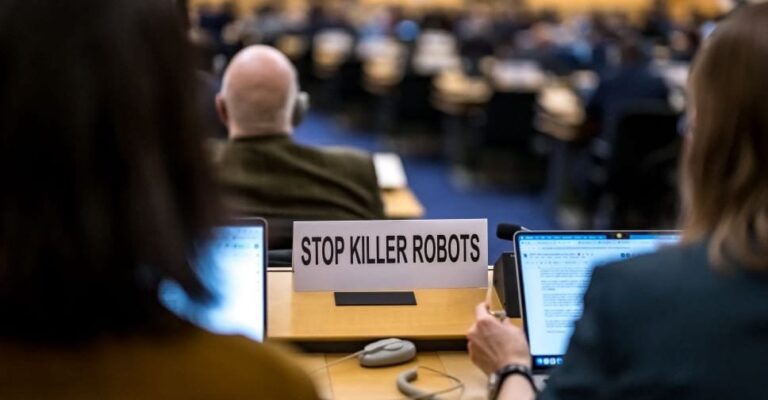
The talks, which concluded early Saturday in Geneva, produced a commitment by participating countries to continue negotiations and develop new rules within two years. However, the outcome fell short of demands for immediate international restrictions on weapons capable of identifying and attacking targets with little or no human intervention.
Approximately 100 countries supported the introduction of legally binding regulations within a defined timeframe. However, opposition from major military powers, including the United States, Russia and Israel, prevented negotiators from reaching a stronger agreement.
The resulting compromise leaves unresolved whether future regulations will be legally enforceable.
Representatives of countries participating in the Convention on Certain Conventional Weapons had gathered in Geneva on Monday amid mounting concerns about the development and deployment of lethal autonomous weapons systems.
Often described as “killer robots,” these weapons use advanced technologies to identify and engage targets with varying degrees of human control.
Their increasing use in conflicts, including those in Ukraine, Sudan and the Middle East, has intensified international debate over the ethical, humanitarian and legal implications of allowing machines to make lethal targeting decisions.
The United Nations secretary-general, Pope Leo XIV and the International Committee of the Red Cross have all called for stronger international safeguards, including legally binding restrictions on weapons that operate without adequate human oversight.
The Geneva discussions were marked by significant disagreements, particularly over the legal status of future regulations and the procedures governing negotiations.
Diplomats said Russian objections to procedural rules forced the cancellation of some formal meetings, further complicating efforts to reach a consensus.
Negotiators reportedly spent several hours debating specific wording before finally reaching a compromise after 4 a.m. local time on Saturday.
Despite the difficulties, the meeting’s Swiss chair, Julien Thoeni, described the agreement as an important achievement for humanitarian disarmament following more than a decade of discussions.
He said the outcome demonstrated that international diplomacy could still produce results despite deep divisions among world powers.
However, a diplomat representing a country that supported stronger regulations acknowledged that the agreement was disappointing, although the outcome could have been worse.
Human rights organizations strongly criticized the outcome, arguing that the failure to establish binding restrictions could allow autonomous weapons technology to develop faster than international laws designed to regulate it.
Nicole van Rooijen, executive director of the advocacy organization Stop Killer Robots, warned that continued delays in establishing enforceable international standards could endanger civilian populations and humanity more broadly.
Campaigners maintain that meaningful human control must remain central to decisions involving the use of lethal force.
They also argue that without clear international regulations, the growing deployment of autonomous weapons could create serious accountability problems when such systems cause unlawful deaths or civilian casualties.
Although the Geneva meeting failed to deliver an immediate legal framework, the commitment to continue negotiations provides another opportunity for countries to address the risks associated with autonomous weapons.
The next two years are expected to be crucial in determining whether governments can overcome their differences and establish internationally recognized standards.
However, the continued opposition of major weapons-producing countries could make a legally binding agreement difficult to achieve.
For human rights advocates, the concern is that military innovation is advancing more rapidly than diplomatic efforts to regulate it.
As artificial intelligence becomes increasingly integrated into modern warfare, the failure to establish effective safeguards raises urgent questions about civilian protection, military accountability and the future of human control over life-and-death decisions.
The outcome of the Geneva talks highlights a widening gap between technological advancement and international regulation, leaving the world without a binding agreement on one of the most controversial developments in modern warfare.