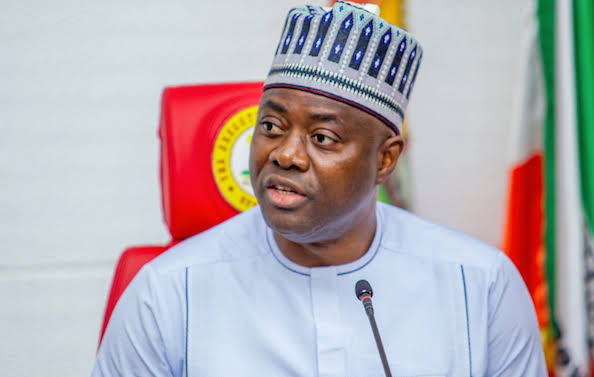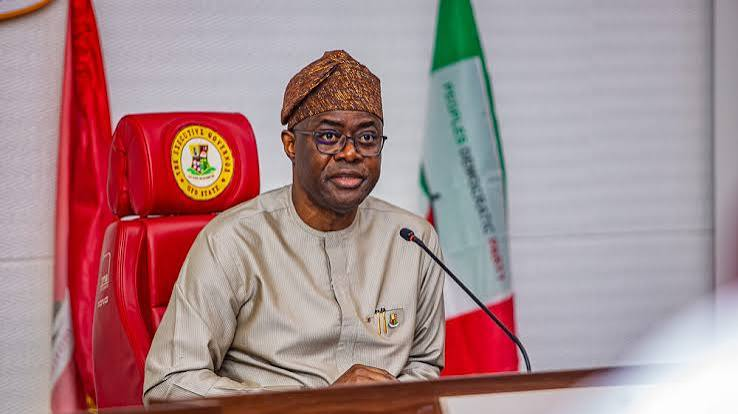
The presidential candidate of the Allied Peoples Movement (APM) for the 2027 general election, Seyi Makinde, has accused the ruling All Progressives Congress (APC) of working to weaken opposition parties and undermine Nigeria’s multiparty democracy.
Makinde made the accusation on Friday during a live interview with Bauchi Radio Corporation (BRC), where he reacted to the recent Federal High Court judgment involving the African Democratic Congress (ADC) and its presidential candidate, Atiku Abubakar.
The Oyo State governor, who was in Bauchi to flag off his presidential campaign, described the development as unfortunate and warned against moves that could push Nigeria towards a one-party state.
“There is no way Nigeria can be a one-party state; the APC must get that clear,” he said.
He urged Nigerians not to lose hope in the country, expressing confidence that a change of government in 2027 would put Nigeria on a better path.
“President Bola Ahmed Tinubu and the APC should allow opposition to breathe. What happened to the ADC and its presidential candidate, Atiku Abubakar is rather unfortunate and undemocratic,” Makinde said.
The APM candidate also criticised the economic policies of the Tinubu administration, arguing that their implementation without adequate planning had worsened living conditions for Nigerians.
He identified insecurity as another major challenge confronting the country, stressing the need for fundamental reforms and political will to address the nation’s economic and security problems.
Makinde said these challenges informed the development of his party’s Reset Nigeria Agenda, which he described as a comprehensive framework for addressing the country’s problems and achieving sustainable development.
He argued that the economic difficulties facing Nigerians began shortly after the current administration assumed office, following the announcement of major policy decisions without a clearly defined implementation framework.
According to him, policies with far-reaching national implications require adequate planning and coordination to minimise their impact on citizens.
Makinde also called for reforms to address Nigeria’s socio-political challenges and strengthen national unity and its federal structure.
He said the country’s founding fathers negotiated a Federal Republic that recognises the existence of different nationalities within one country, adding that Nigeria’s diversity should be a source of strength rather than division.
“Nigeria was established by our founding fathers, who negotiated a federal republic. This means we must acknowledge that there are several nations within one nation. We must, therefore, find a way to work together, ensuring that our diversity becomes a source of unity as we pursue a common goal,” he said.
Explaining his party’s Reset Nigeria Agenda, Makinde said it identifies key areas requiring urgent reforms and outlines the reasons for the proposed changes in its manifesto.
He said the agenda was developed partly from his experience of challenges associated with poor coordination and the over-centralisation of power.
“When we developed the Reset Agenda for the country, it was informed by our firsthand experience of challenges relating to coordination and the over-centralisation of power,” he said.
Makinde explained that the agenda rests on four major pillars arranged according to priority, with the economy as the foremost focus.
He said the ultimate goal was to ensure that government policies translate into tangible improvements in the lives of ordinary Nigerians.
“We want Nigerians to feel the impact of our policies, and that is precisely what we intend to address,” he said.