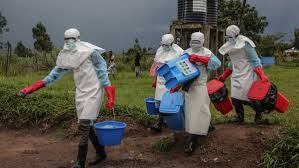
A court in Kenya on Friday temporarily blocked a U.S.-backed plan to establish a quarantine facility for Americans exposed to a rare Ebola strain spreading in northeastern Democratic Republic of the Congo, following strong opposition from medical professionals and civil society groups.
The proposed facility became public after a U.S. administration official revealed Wednesday that Americans exposed to Ebola overseas could be sent to Kenya for quarantine instead of being transported back to the United States. The official spoke on condition of anonymity and did not specify where the facility would be located or whether Kenyan authorities had formally approved the proposal.
While the Kenyan government acknowledged ongoing discussions with Washington regarding Ebola preparedness assistance, officials did not directly address reports of a quarantine center. Meanwhile, U.S. Secretary of State Marco Rubio announced that Washington intends to provide $13.5 million to support Kenya’s Ebola preparedness efforts.
The High Court of Kenya in Nairobi ordered a pause on any agreement related to the proposed facility until legal challenges can be heard on Tuesday.
Two organizations, Katiba Institute and Law Society of Kenya, filed separate petitions opposing the project. The Law Society asked the court to invalidate any agreements between Kenya and the United States, arguing that the proposal poses public health risks and lacks sufficient public consultation.
The organization also contended that Kenya does not possess the specialized high-containment infrastructure necessary to safely operate such a facility, potentially exposing the public to significant health hazards.
Opposition has also come from the medical community. A Kenyan doctors’ union issued a 48-hour strike notice on Thursday, warning of industrial action if the government proceeds with the arrangement.
Union leaders criticized the proposal, arguing that if the United States is unwilling to house Ebola-exposed individuals on its own territory, Kenya should not be expected to do so.
“As the vanguard of Kenya’s healthcare system, we are utterly disgusted by the government’s apparent willingness to trade national biosecurity and the lives of its citizens for foreign aid,” said union chairman Davji Atellah.
The controversy comes as health officials in northeastern Congo struggle to contain an outbreak of the Bundibugyo Ebola virus disease, a rare form of Ebola for which there are currently no approved vaccines or treatments.
Congolese authorities have reported more than 1,000 suspected infections and at least 220 deaths since officially declaring the outbreak on May 15. However, health experts believe the actual number of cases may be significantly higher because the virus circulated undetected for several weeks before being identified.
The outbreak has also spread beyond Congo’s borders. Neighboring Uganda has confirmed seven cases and one death linked to the virus.