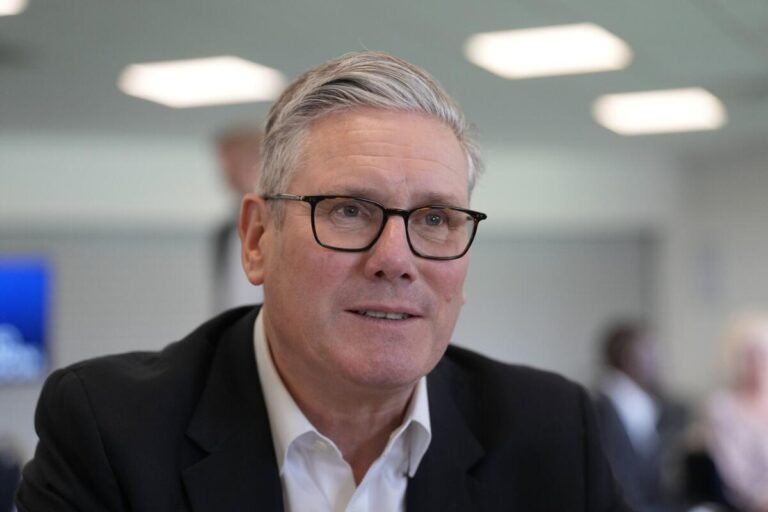
British Prime Minister Keir Starmer is facing growing pressure over his leadership after severe local election losses triggered calls from dozens of lawmakers within the Labour Party for him to step down.
Starmer is expected to use a major speech on Monday to convince critics that he can reset his government’s direction and restore public confidence. But tensions within the party continue to rise, with Labour MP Catherine West warning she could push for a leadership challenge depending on the prime minister’s remarks.
Former Deputy Prime Minister Angela Rayner, widely viewed as a possible rival to Starmer, stopped short of openly calling for his resignation but said the party “needs to change.”
“The prime minister must now meet the moment and set out the change our country needs,” Rayner said.
Labour suffered major setbacks in local elections across England, as well as legislative contests in Scotland and Wales. The results were widely interpreted as a referendum on Starmer’s leadership less than two years after Labour returned to power in a landslide victory.
The government has struggled to deliver on key promises, including boosting economic growth, improving strained public services, and reducing pressure from the rising cost of living. Starmer has also faced criticism over policy reversals and controversial appointments, including naming Peter Mandelson as Britain’s ambassador to Washington.
The elections exposed Labour’s vulnerability on both sides of the political spectrum, with voters shifting toward the anti-immigration Reform UK as well as the Green Party of England and Wales.
Despite the turmoil, Starmer told The Observer newspaper that he intends to remain in office for the long term and is looking to regain momentum through upcoming policy announcements and legislative proposals expected during the State Opening of Parliament led by King Charles III.
A central part of Starmer’s strategy involves strengthening ties with the European Union after the United Kingdom’s departure from the bloc in 2020. His government has already sought to ease some post-Brexit trade barriers and is pursuing a youth mobility agreement aimed at allowing young people to work across Europe more easily.
“Brexit has held back our young people,” Starmer told the newspaper. “We have to be closer to Europe.”