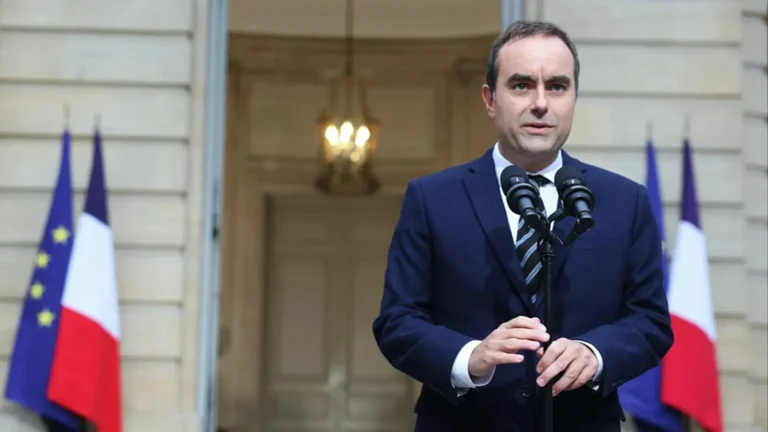
French Prime Minister Sébastien Lecornu has resigned less than a month after taking office, plunging the country into fresh political uncertainty amid ongoing economic challenges and deepening parliamentary gridlock.
Lecornu, a close ally of President Emmanuel Macron and former defense minister, tendered his resignation on Sunday—just hours after announcing his cabinet lineup. The government was scheduled to hold its first meeting on Monday, with Lecornu set to present his policy roadmap to the National Assembly on Tuesday.
His abrupt departure marks the fifth prime ministerial resignation in under two years, highlighting the ongoing instability within Macron’s administration and the mounting difficulty of governing without a parliamentary majority.
Lecornu had been appointed in early September with a clear mandate: pass the 2026 national budget and restore confidence in France’s fiscal management. His resignation now threatens to derail that effort.
France’s 2024 budget deficit currently stands at 5.8% of GDP, nearly double the European Union’s 3% limit, while public debt has surged to 113% of GDP, far exceeding EU guidelines. European Commission officials and investors had been closely monitoring Lecornu’s tenure, anticipating clarity on proposed spending cuts and revenue measures.
His departure just days before outlining a plan to reduce the deficit adds to concerns over France’s economic direction.
The resignation piles further pressure on President Macron, who has faced sustained difficulties since losing his absolute majority in 2022. Three previous minority governments have collapsed, and Lecornu’s exit underscores the political fragility of the current administration.
With no clear successor named, the resignation raises the prospect of another protracted government formation process—or even the possibility of snap legislative elections.
The political shockwave comes as France plays a key role in EU economic recovery efforts. A stable French government is considered essential to broader eurozone fiscal reforms.
Markets are expected to react with caution when trading opens Monday, with analysts warning that prolonged political uncertainty could dent investor confidence and raise borrowing costs.
Lecornu’s resignation, though unexpected, reflects the broader challenges facing Macron as he attempts to implement unpopular austerity measures in a deeply polarized political environment. As one of the bloc’s leading economies confronts instability at home, questions are mounting about how—and if—France can deliver on its promises.