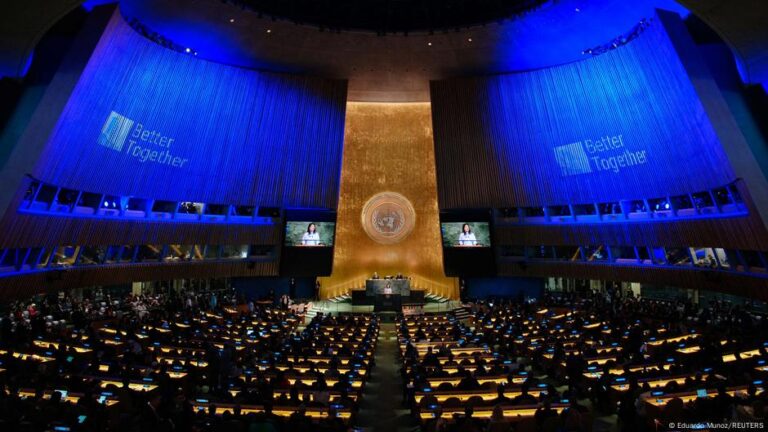
World leaders convening in New York for the 80th United Nations General Assembly opened the week’s high-level diplomacy on Monday with a bold collective push to revive the long-stalled Israeli-Palestinian peace process — with several nations formally declaring their recognition of a Palestinian state.
At a packed summit co-hosted by France and Saudi Arabia, French President Emmanuel Macron made the announcement to resounding applause.
“The time for peace has come,” Macron declared. “We’re only moments away from losing the chance to achieve it altogether. Some may say it’s too early, others say too late — but one thing is clear: we cannot afford to wait any longer.”
France joins a growing bloc of countries, including the United Kingdom, Belgium, Portugal, Australia, and Canada, pledging formal recognition of Palestinian statehood. The movement now includes over 140 nations worldwide and marks an intensifying diplomatic campaign to resurrect the two-state solution as violence in Gaza and the West Bank reaches new peaks.
Israel and U.S. Boycott, Dismiss Event as ‘Theater’
But the show of unity was met with firm resistance from Israel and the United States, both of which boycotted the meeting.
Danny Danon, Israel’s permanent representative to the United Nations, dismissed the summit as “a piece of political theater” intended to serve domestic interests in host nations rather than diplomatic progress.
“This is detached from reality,” Danon told reporters. “While Macron and others celebrate, 48 Israeli hostages remain in Hamas captivity in Gaza. The U.S. and Israel will not participate in this charade.”
The White House has echoed similar sentiments, accusing participating nations of “rewarding Hamas” — which the U.S. designates a terrorist organization — and downplaying the recognitions as largely symbolic.
Despite that, some diplomats and analysts warn that symbolism could carry significant repercussions.
As global momentum builds toward recognizing Palestinian sovereignty, concerns are mounting that Israeli Prime Minister Benjamin Netanyahu may respond with unilateral actions — including the potential annexation of parts of the occupied West Bank. Israeli officials have not ruled out retaliatory steps and have repeatedly condemned the international effort as undermining Israel’s security.
Meanwhile, advocates for Palestinian statehood argue that inaction would be far more dangerous. With civilian deaths mounting and humanitarian conditions deteriorating in Gaza, they say, delaying recognition only perpetuates instability and violence.
While key issues remain unresolved — such as borders, governance, and security arrangements — Monday’s summit signaled a dramatic shift in diplomatic tone, and a growing impatience among the global community to see progress in one of the world’s most protracted conflicts.