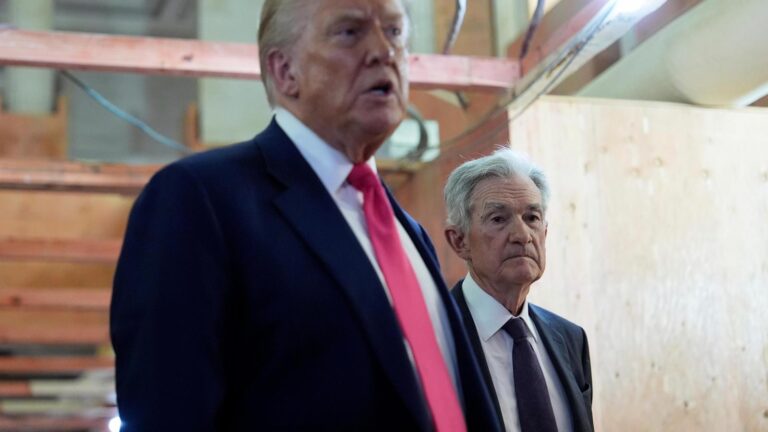
The Federal Reserve is widely expected to keep its benchmark interest rate unchanged on Wednesday for the fifth consecutive meeting, highlighting a growing rift between Chair Jerome Powell and President Donald Trump over the direction of U.S. economic policy.
Although the Fed’s decision is expected to maintain the status quo, internal tensions are rising. Economists anticipate that two members of the central bank’s board — both appointed by Trump — may dissent in favor of a rate cut. If confirmed, it would be the first time since 1993 that two sitting governors vote against the Fed chair’s position.
The divide between the Fed and the White House has become unusually pronounced. Trump argues that the strength of the U.S. economy justifies lower interest rates — drawing a comparison to top-tier corporations that borrow at cheaper rates than riskier start-ups.
But Fed officials, along with most economists, see things differently. They contend that a robust economy demands higher interest rates to prevent overheating and control inflation.
“Our interest rates are higher because our economy is performing well — not despite it,” said Gennadiy Goldberg, head of U.S. rates strategy at TD Securities.
Trump has also criticized Powell personally, claiming that the Fed’s reluctance to lower rates is costing taxpayers hundreds of billions in interest payments. However, central bank officials maintain that their mandate is not to reduce the government’s borrowing costs but to ensure price stability and full employment — goals set by Congress.
“It’s dangerous to use monetary policy as a tool to relieve pressure on fiscal policymakers,” warned William English, a Yale School of Management economist and former senior Fed official. “That path leads to higher inflation and deeper long-term problems.”
Economists caution that if the Fed is seen as trying to ease federal debt burdens instead of targeting inflation and employment, financial markets could lose confidence. That, in turn, might drive up interest rates across the economy as investors demand higher returns to offset inflation risks.
The policy clash between Powell and Trump is expected to persist beyond Powell’s current term, which ends in May 2026. With economic indicators still showing strength and inflation remaining a concern, the Fed appears intent on holding steady — even as political pressure mounts from the White House.
The outcome of Wednesday’s meeting will offer fresh insight into how the central bank is balancing economic fundamentals with growing political scrutiny in a contentious election year.