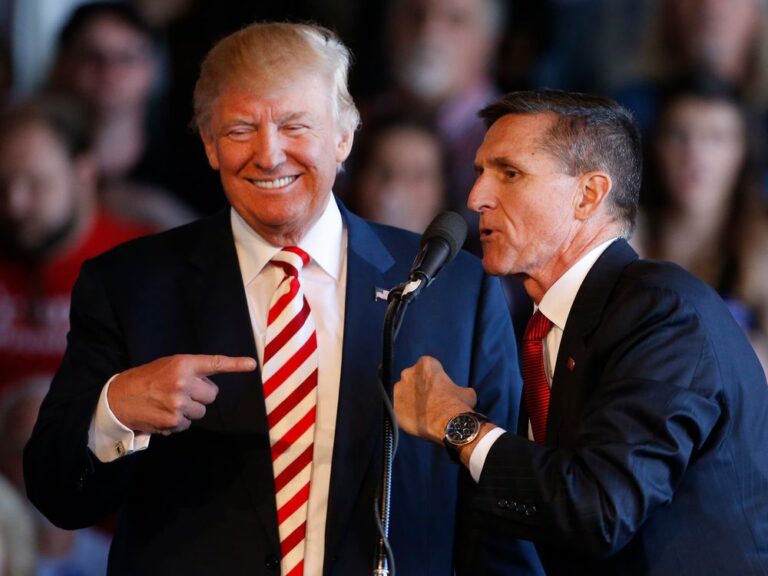
President Donald Trump announced in a tweet Wednesday that he has granted his first national security adviser, Michael Flynn, a “full pardon,” wiping away the guilty plea of the intelligence official, lobbyist and conservative fringe darling for lying to the FBI.
The pardon, coming as Trump enters his last days as President, bookends his four years in office and his supporters’ revisionist take on the investigation into Russian interference in the 2016 presidential election. Since January 2017, the Flynn case has been among the defining scandals and sagas of Trump’s presidency and Attorney General William Barr’s leadership of the Justice Department.
Flynn’s criminal charge had hung over the Trump presidency and shaded nearly every major scandal Trump faced, because Flynn’s lies to the FBI had occurred days into the new administration and were about his transition-time contacts with Russia, which opened the door for warmer relations with a country that had just meddled in the US presidential election.
The pardon also ends a three-year legal saga where, most recently, Flynn’s charge hung in an appeals court in a fight over separation of powers, while the Justice Department was trying to drop the case. The trial-court judge overseeing the case had not taken action since the appeals fight, and was considering whether to dismiss the case or to sentence Flynn. The Justice Department has said Flynn never should have been investigated by the FBI and that his lies to them in January 2017 were immaterial, while Flynn recanted his admissions of guilt.
The White House, in a statement following the President’s announcement, insisted on Flynn’s innocence, with press secretary Kayleigh McEnany saying in part: “The President has pardoned General Flynn because he should never have been prosecuted.”
The pardon brings “to an end the relentless, partisan pursuit of an innocent man,” McEnany wrote. The White House did not provide any evidence of Flynn’s innocence in the statement.
Trump said in March that he was “strongly considering” pardoning Flynn and had told aides in recent days that he planned to pardon him before leaving office.
A Justice Department official said on Wednesday that they were not consulted about a pardon and instead were notified in advance of the President exercising his pardon power for Flynn. The Department would have preferred to have seen the case resolved with a dismissal in court, the official added.
The judge in Flynn’s case, Emmet Sullivan of the US District Court in DC, may also have questions left in the case, as could the next Justice Department in the Biden administration. In addition to pleading guilty to one charge, Flynn admitted to lying about his lobbying for Turkey but was not charged with that crime. During the legal proceedings, Sullivan has also asked probing questions about the lawyering around the case, and it is unclear if the judge will attempt to continue his inquiries.
The pardon is likely to play into Trump’s legacy, as he continues to rail against democratic institutions and had used Flynn as a political symbol to rally his supporters. Trump’s critics have claimed for months the administration has abused its power and undermine the rule of law to help former advisers and friends.
Flynn’s pardon is the second presidential act of clemency related to prosecutions of advisers of the President. The first was Roger Stone.
“It is my Great Honor to announce that General Michael T. Flynn has been granted a Full Pardon. Congratulations to [Flynn] and his wonderful family, I know you will now have a truly fantastic Thanksgiving!” Trump’s tweet on Wednesday afternoon said.
Flynn, apparently in response, tweeted a reference to a Bible verse from the Book of Jeremiah: ” ‘They will fight against you but will not overcome you, for I am with you and will rescue you,’ declares the Lord.”