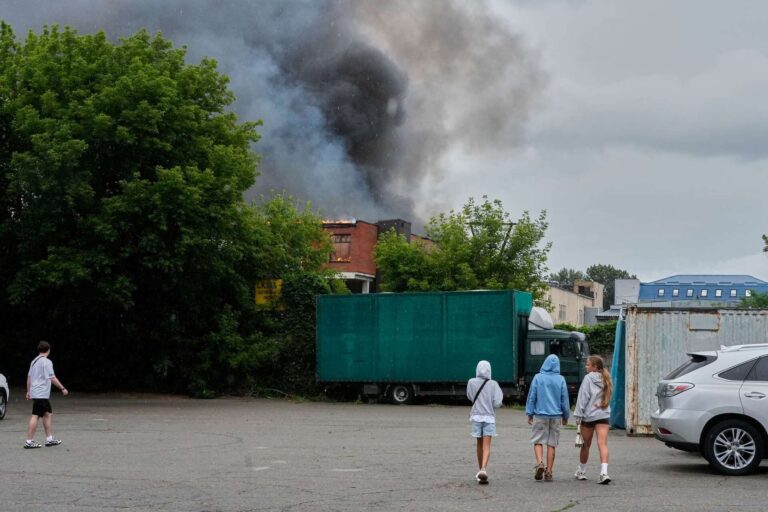
Ukraine launched a fresh wave of long-range drone attacks on Russian energy infrastructure on Thursday, igniting multiple oil facilities and setting two oil tankers ablaze in the Sea of Azov as Kyiv intensified efforts to disrupt Moscow’s fuel supplies.
The strikes came a day after President Donald Trump pledged to allow Ukraine to manufacture Patriot air defense systems under a new licensing arrangement.
Ukraine has increasingly targeted Russian oil refineries, fuel depots and transportation infrastructure, a campaign that has contributed to gasoline shortages, fuel rationing and long lines at service stations across several Russian regions.
In Russia’s western Tver Oblast, acting Governor Vitaly Korolyov said a Ukrainian drone strike sparked a fire at an oil depot in the city of Tver.
Further south, Governor Vladimir Vladimirov reported that drone attacks ignited oil storage reservoirs in the Vyazniki area of Stavropol Krai.
Authorities ordered the evacuation of residents from several nearby apartment buildings as firefighters worked to contain the expanding blaze.
In the Sea of Azov, two oil tankers caught fire after being struck by Ukrainian drones, according to Yuri Slusar.
Slusar said one vessel was still burning while both crews were safely evacuated.
The attack was the latest in a series of strikes targeting oil tankers operating near the Sea of Azov, part of Ukraine’s broader campaign to disrupt fuel deliveries to Russian-occupied Crimea.
Ukrainian President Volodymyr Zelenskyy said the operation extended well beyond the reported attacks in Tver and Stavropol.
According to Zelenskyy, Ukrainian forces also struck a strategic fuel reserve located roughly 800 kilometers (500 miles) from the front line, an oil pumping station in Ufa nearly 1,500 kilometers (930 miles) from Ukraine’s border, and an oil-loading terminal in Russia’s Rostov Oblast.
It was not immediately clear whether the strike on the Rostov oil terminal was the same incident reported by regional authorities involving the burning tankers.
The latest attacks underscore Ukraine’s continued strategy of targeting Russia’s energy infrastructure deep behind the front lines, seeking to weaken military logistics and place additional economic pressure on Moscow as the war continues.