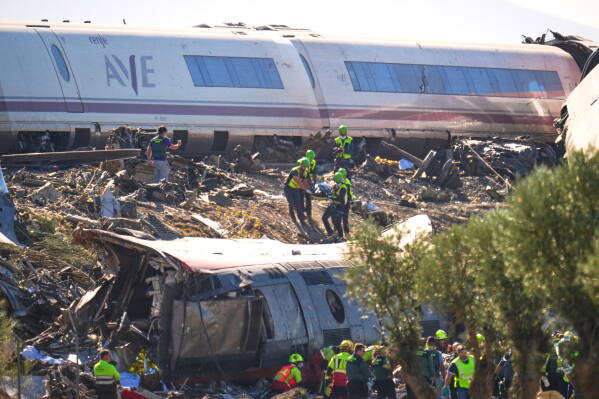
The collision, which occurred Wednesday near the town of Urda, has triggered a dispute between government officials and railway unions over whether human error or deeper operational failures were responsible.
Spain’s transport minister has attributed much of the blame to poor judgment by a railway traffic controller. However, union representatives argue that deteriorating working conditions, staffing shortages and increasing workloads may have contributed to the disaster.
The tragedy has intensified scrutiny of a rail system long regarded as one of Europe’s most successful transportation projects.
Emergency responders and investigators continued working at the crash site Friday, with police officers and specially trained sniffer dogs searching through the wreckage.
Regional authorities warned that the death toll, currently standing at 69, could increase as recovery operations continue.
Investigators are examining the circumstances surrounding the collision, including decisions made by railway traffic controllers and the operational conditions on the Madrid-Seville high-speed line.
The scale of the disaster has raised urgent questions about how such a collision could occur on a network widely recognized for its advanced infrastructure and safety systems.
Spain’s transport minister moved quickly to identify what he described as a serious error in judgment by a railway traffic controller as a major factor in Wednesday’s collision.
The government’s preliminary assessment has placed significant attention on the decisions made during train operations before the crash.
However, the full circumstances remain under investigation, and the precise sequence of events leading to the collision has not been conclusively established.
The focus on individual responsibility has prompted objections from railway unions, which argue that the broader operating environment must also be examined.
Railway unions have challenged the suggestion that the disaster can be explained primarily by human error.
They argue that worsening working conditions have placed increasing pressure on traffic controllers responsible for coordinating train movements across Spain’s extensive railway network.
According to union representatives, fewer controllers are being required to manage heavier workloads, making it increasingly difficult to maintain the level of attention and oversight necessary for safe operations.
The unions say these pressures are particularly concerning for a railway system that carries approximately 45 million passengers annually.
Their concerns have shifted attention toward staffing levels, workload management and the adequacy of operational safeguards.
The competing explanations have created pressure for a comprehensive investigation that examines both individual decisions and potential systemic weaknesses.
Wednesday’s tragedy is the second major railway disaster on the Madrid-Seville route in 2026.
In January, a separate collision occurred farther south near Adamuz when one train derailed and struck another traveling in the opposite direction.
That crash killed 46 people.
Together, the two disasters have claimed at least 115 lives this year, dealing a severe blow to public confidence in Spain’s high-speed railway system.
The fact that both incidents occurred along the same major route has intensified calls for a thorough examination of railway safety procedures and infrastructure.
Spanish Prime Minister Pedro Sánchez visited the crash site near Urda on Friday, expressing concern over the two deadly incidents.
“It is unacceptable that a country like Spain with such a strong high-speed railway has two accidents of this type in the same year,” Sánchez said.
His remarks reflected growing concern about the reliability of a transportation system that has long been a source of national pride.
The prime minister’s visit came as investigators continued examining the wreckage and families awaited further information about the victims.
Spain operates the world’s second-largest high-speed railway network, surpassed only by China.
The system has been widely regarded as a successful example of government investment in modern transportation infrastructure.
Since beginning operations more than three decades ago, Spain’s high-speed rail network had maintained a strong safety record, with no fatal crashes reported until this year.
The two deadly collisions in 2026 have now challenged that reputation and raised questions about whether the network’s rapid expansion and operational demands have been matched by sufficient safety resources.
As Spain mourns the victims, attention is increasingly turning toward preventing another disaster.
The investigation will need to establish whether Wednesday’s collision resulted from individual mistakes, shortcomings in traffic management or wider operational problems.
Railway unions are calling for greater scrutiny of staffing and working conditions, while government officials have emphasized the role of the traffic controller’s decisions.
For passengers and families affected by the tragedy, the central question remains how two catastrophic collisions could occur within months on a railway system previously celebrated for its safety.
With recovery operations continuing and the death toll potentially rising, the findings of the investigation could have significant consequences for Spain’s railway authorities and the future management of its high-speed rail network.