A worsening drought across Europe is disrupting energy production, trade and economic activity, forcing several countries to take extraordinary measures as rivers fall to historically low levels.
Romania has temporarily shut down its only operational nuclear reactor cooled by the Danube River for the first time, after declining water levels threatened the plant’s cooling capacity.
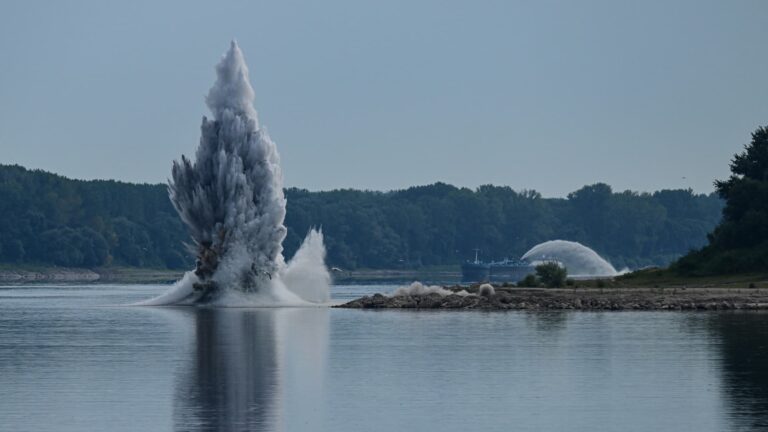
To improve water flow, Romanian authorities deployed naval forces to carry out controlled underwater explosions near the village of Izvoarele, where rocks were blasted from the riverbed in an effort to channel more water toward the cooling systems of the Cernavodă Nuclear Power Plant.
Images released on Monday showed the Romanian Navy conducting the operation as part of emergency efforts to safeguard the country’s energy infrastructure.
The drought has also placed pressure on neighboring countries.
In Hungary, low water levels on the Danube have raised concerns over operations at the Paks Nuclear Power Plant, which generates about 40% of the country’s electricity, while Serbia has been forced to reduce hydropower production because of declining river flows.
Germany is facing similar challenges as water levels on the Rhine River—one of Europe’s busiest commercial waterways—have dropped to their lowest point in nearly 150 years.
Official data compiled by ETH Zurich showed that water levels at Kaub, a critical shipping bottleneck linking southern Germany and Switzerland, fell to just 24 centimeters on Monday and Tuesday, the lowest reading since measurements began in 1880.
Forecasters expect water levels to decline even further later this week.
The current level is well below the 78-centimeter threshold considered critical for commercial navigation.
Although shipping remains possible, cargo vessels must carry significantly lighter loads, driving up transportation costs and increasing low-water surcharges for freight operators.
The Rhine serves as a vital transport route for raw materials, fuel and manufactured goods, meaning prolonged disruptions could further strain supply chains and Europe’s largest economy.
Experts warn that the consequences extend well beyond river transport.
“Major rivers like the Rhine and Danube are critical trade corridors and sources of water for industry and energy generation, so when water levels fall, the effects extend far beyond the waterways themselves,” Liz Saccoccia, water security lead at the World Resources Institute, told CNBC.
As Europe endures another summer of extreme weather, governments are increasingly being forced to balance energy security, industrial production and environmental pressures while responding to one of the continent’s most severe droughts in decades.