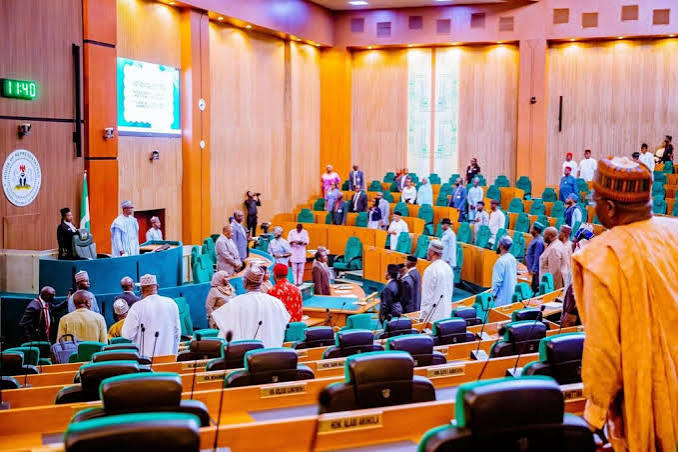
Former senator Dino Melaye has accused the 10th National Assembly of failing to check President Bola Tinubu’s powers, alleging that lawmakers have compromised their independence by yielding to the executive.
Melaye, deputy director-general for contact and mobilisation of the African Democratic Congress (ADC) presidential campaign, threatened to organise an “Occupy National Assembly” protest if lawmakers failed to address his concerns within 14 days.
He issued the ultimatum at a press conference in Abuja on Wednesday, titled ‘The 10th Assembly: The Pathway to Tinubu’s Lifetime Presidency’.
“We are giving the national assembly 14 days to respond in corrective lines to all our demands and all grey areas where they have disappointed Nigeria and Nigerians; failure to do so, we will march on the national assembly, and it will be very loud,” Melaye said.
The former lawmaker said the legislature’s handling of executive powers, electoral reforms, budget implementation and constitutional procedures had raised questions about its ability to perform its oversight responsibilities independently.
“A lifetime presidency does not begin with the abolition of term limits. It begins when the institutions created to restrain a President stop restraining him,” he said.
Melaye argued that the Constitution established separate arms of government to prevent the concentration of power in one individual.
“The president possesses enormous executive power. Parliament controls legislation, appropriation and oversight. The courts interpret the law. Each arm must respect the others, but none was created merely to validate the wishes of another,” he said.
He clarified that his criticism was not directed at cooperation between the executive and legislature but at what he described as the failure to maintain institutional independence.
“This is not an argument that parliament must oppose everything the president proposes. Cooperation between the executive and legislature is constitutional and necessary. But cooperation is different from submission,” he added.
Melaye cited the July 2024 amendment to the Nigeria Police Act as an example of what he considered inadequate legislative scrutiny of executive proposals.
He said the amendment, initiated by Tinubu, allowed an Inspector-General of Police to remain in office until the end of the tenure specified in the appointment letter, notwithstanding the ordinary retirement provisions.
Questioning the speed with which the legislation was passed, Melaye said the bill underwent three readings in both chambers on the same day.
“One day. Three readings. Two chambers. What urgency required an Executive Bill governing the tenure of the Inspector-General of Police to travel from introduction to final passage through both chambers in a single day?” he asked.
He also questioned the National Assembly’s approval of the state of emergency declared in Rivers State in March 2025, particularly the use of voice votes by both chambers.
Melaye argued that the procedure did not establish whether the constitutionally required two-thirds majority of all members had been secured.
“When the Constitution requires two-thirds of all members, should Nigerians not be entitled to know precisely who constituted that two-thirds?” he asked.
The ADC chieftain further raised concerns about a proposal announced by Senate Leader Opeyemi Bamidele in June 2026 to introduce a single six-year tenure for presidents and governors.
He said any constitutional amendment would require clear transitional provisions, particularly if considered after the 2027 general election.
“Would the single six-year term apply prospectively only to Presidents elected after the amendment?” Melaye asked.
“Would a president elected in 2027 under a four-year constitutional mandate remain bound to that four-year mandate?”
He urged Nigerians to scrutinise proposed changes to presidential tenure, warning against altering an incumbent president’s term before clearly explaining the legal basis and implications.
“Nigeria must never reach the stage where the tenure of an incumbent president is altered first and explained afterwards,” he said.