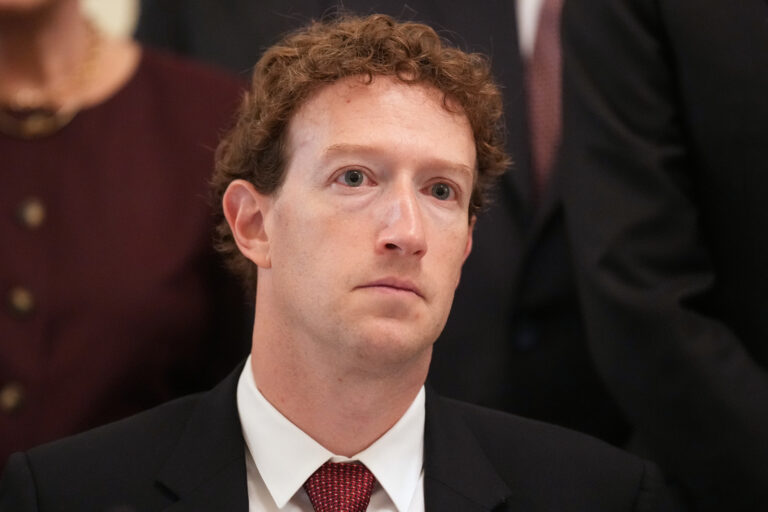
According to regulatory filings published this week, the arrangement would enable Zuckerberg to sell newly created non-voting shares while maintaining control of the company he founded.
The agreement comes ahead of California’s November 3 election, when voters are expected to decide on a proposed one-time 5% wealth tax targeting residents with a net worth exceeding $1 billion.
Zuckerberg, currently ranked as the world’s sixth-richest person by Forbes, has an estimated fortune exceeding $220 billion.
Based on that valuation, the proposed tax could leave him facing a bill of more than $11 billion.
Under measures announced Wednesday, Meta will establish a structure allowing Zuckerberg to sell shares that do not carry voting rights.
The arrangement would enable him to raise substantial funds without giving up the voting control he currently exercises over the company.
Regulatory filings indicate that Zuckerberg would be permitted to sell the new shares “for any reason,” including to meet potential obligations arising from California’s proposed wealth tax.
The agreement also follows discussions about whether Zuckerberg would remain a California resident if the measure became law.
According to the filings, Zuckerberg informed Meta’s board last month that he was considering selling his home in Palo Alto in anticipation of the tax.
However, following the agreement, he committed to remaining in California for eight years.
The commitment includes an exception for “material unforeseen circumstances” that could make relocating elsewhere prudent or advisable.
The proposed wealth tax would apply to individuals whose primary residence was in California on January 1, 2026, and whose net worth exceeded $1 billion.
According to California’s nonpartisan Legislative Analyst’s Office, the state is home to several hundred billionaires who could potentially fall within the measure’s scope.
Supporters say the tax would generate substantial revenue to address funding shortfalls in essential public services.
Most of the proceeds would be directed toward offsetting federal funding cuts affecting health care, while 10% would support education and food assistance programs.
The proposal has attracted support from the SEIU United Healthcare Workers West union and Vermont Senator Bernie Sanders.
Advocates argue that taxing accumulated wealth would help ensure that billionaires contribute a greater share of their financial resources toward public needs.
Despite support from labor organizations and progressive lawmakers, the proposal has faced opposition from several prominent political and business figures.
California Governor Gavin Newsom, a Democrat, has warned that imposing the tax could encourage wealthy residents to relocate to other states.
Critics argue that such departures could ultimately weaken California’s finances because the state depends heavily on income tax payments from high-earning residents.
The potential loss of wealthy taxpayers could create longer-term budget challenges, opponents say.
However, supporters of the measure point to Zuckerberg’s agreement with Meta as evidence that billionaires may choose to remain in California rather than leave.
Suzanne Jimenez, chief of staff at SEIU United Healthcare Workers West, welcomed the development.
“This is the nail in the coffin to months of scare tactics claiming that billionaires are fleeing California,” Jimenez said in a statement.
Zuckerberg’s agreement highlights how some of America’s wealthiest individuals are preparing for the possibility of a tax on their accumulated assets.
Unlike traditional income taxes, the proposed measure would target overall net worth, including investments and ownership stakes in major companies.
For technology founders whose fortunes are largely tied to company shares, paying such a tax could require selling significant portions of their investments.
Zuckerberg’s arrangement with Meta offers a way to generate liquidity while preserving his voting power.
Other technology billionaires have reportedly taken a different approach.
Google co-founders Sergey Brin and Larry Page are among those who have begun reducing their ties to California amid concerns about the proposed tax.
The contrasting responses illustrate the uncertainty surrounding the measure and its potential impact on the state’s wealthy residents.
As the November 3 vote approaches, the proposal has become a major debate over taxation, economic competitiveness and the responsibility of the ultrawealthy to support public services.
For Zuckerberg, the agreement provides a financial option should the measure pass, while allowing him to retain control of Meta and, under the terms of the arrangement, continue living in California.