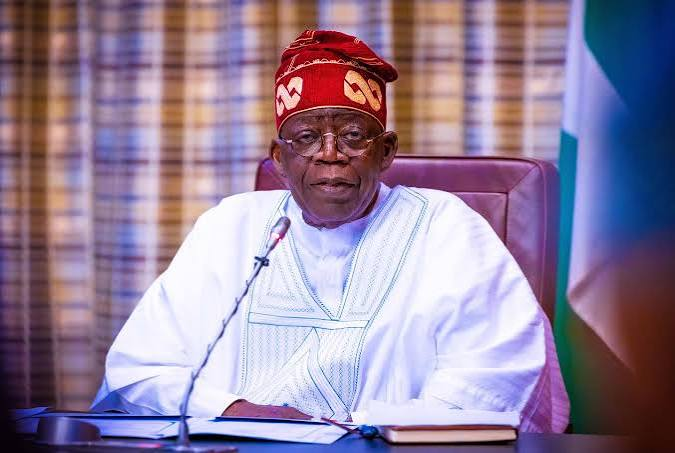
President Bola Ahmed Tinubu has said the Federal Government cannot achieve its $1 trillion economy target without private sector investment, manufacturing and enterprise, stressing that businesses must lead wealth creation.
He said Nigeria’s path to prosperity depended on increased production rather than higher taxation, adding that his administration was harmonising taxes to eliminate multiple taxation and encourage business growth.
“We cannot tax our way into prosperity; we must produce our way there,” he said.
Tinubu spoke at the presentation of a book titled Economic Diversification and Structural Transformation in Nigeria: The Past, The Present, The Future, written by a member of the House of Representatives, Abdulmumin Jibrin Kofa.
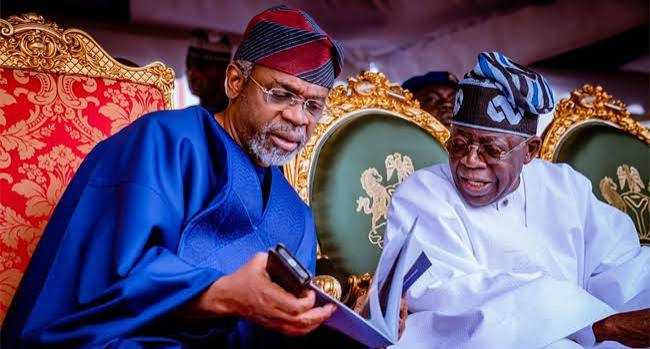
Represented by the Speaker of the House of Representatives, Tajudeen Abbas, the President said he inherited a challenging economic situation marked by a weakening naira, high debt-service obligations, depleted foreign reserves, fuel subsidy costs and declining industrial activity.
He said his administration chose far-reaching reforms over what he described as cosmetic solutions to the country’s economic challenges.
“One was the comfortable road of cosmetic remedies that had led us to the edge of the cliff. The other was the hard road of surgery to save the patient.”
“We chose reform over ruin. We removed the fuel subsidy. We unified the exchange rate. These were not easy decisions, and I know the weight they placed on every household. But they were necessary, and today the pain is yielding its promise,” he said.
Tinubu said non-oil activities now account for about 96 per cent of Nigeria’s Gross Domestic Product, while non-oil exports have exceeded $6 billion, the highest in the country’s history.
He also put Nigeria’s external reserves at about $55 billion, representing more than 14 months of import cover, while non-oil revenue rose from N13.63 trillion in 2023 to N16.4 trillion in the first half of 2026.
The President said the administration had shifted its focus from economic stabilisation to shared prosperity, with a target of building a $1 trillion economy by 2030 under the Medium-Term National Development Plan 2026–2030.
He identified private businesses as central to achieving the target, saying the government’s role was to provide an enabling environment for investment and production.
According to him, the 2025 budget introduced a De-risking Framework to attract private capital, which is expected to provide 86 per cent of the investment required to achieve the 2030 ambition.
Meanwhile, former presidential spokesman, Dr Reuben Abati, warned that the benefits of the economic reforms must extend to ordinary Nigerians rather than remain concentrated among a privileged few.
Abati, who reviewed the 526-page book, said the ultimate objective of economic reforms should be to improve citizens’ living conditions.
He cautioned that macroeconomic stability without corresponding improvements in household welfare could weaken public support for government policies.
He identified declining purchasing power and rising living costs as major concerns, warning that resistance to reforms could come from organised labour, political groups and Nigerians facing economic hardship.
“Certainly, the purpose of reform must not be the enrichment of a privileged minority at the expense of the people’s prosperity,” he declared.
In his welcome address, the author, Jibrin, said the book examined previous efforts to diversify Nigeria’s economy, including policies that were proposed but never implemented, as well as reforms introduced by the current administration.
He said the publication aimed to provide an empirical account of how Nigeria could reduce its dependence on oil for foreign exchange earnings by harnessing opportunities in agriculture, technology, solid minerals, industrial manufacturing and the creative industry.
Jibrin, who has chaired House committees on Finance, Appropriations, Land Transport, Foreign Affairs, and Housing and Habitat, said the book also drew on his legislative and practical experience.
He expressed the vision of moving Nigeria from an oil-dependent economy to one driven by broader productivity and a stronger economic foundation.