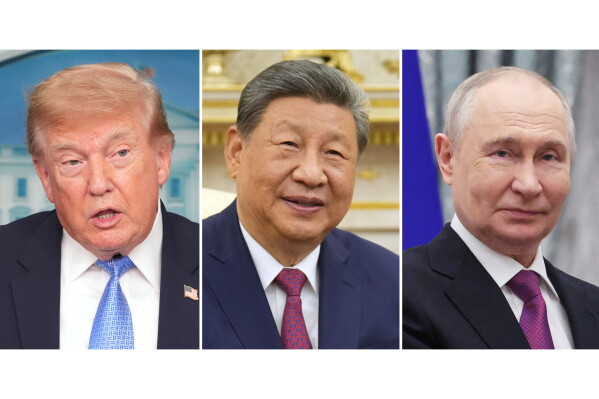
US President Donald Trump, Chinese President Xi Jinping and Russian President Vladimir Putin are scheduled to meet on Thursday, November 19, on the sidelines of the Asia-Pacific Economic Cooperation summit in Shenzhen, a major technology hub in southern China.
The White House confirmed the planned meeting on Friday, describing it as a significant diplomatic engagement involving the leaders of the world’s three major nuclear powers.
Although the gathering is expected to attract worldwide attention, political analysts have cautioned that the summit may produce more symbolic gestures than concrete agreements, given the deep divisions between the countries.
One of the central issues expected to dominate the meeting is the future of global nuclear arms control, particularly following the expiration of the New START treaty between Washington and Moscow in February.
The agreement had placed limits on the strategic nuclear arsenals of the United States and Russia, the world’s two largest nuclear powers.
Its expiration removed the last remaining binding restrictions on their strategic nuclear weapons, raising concerns about the possibility of a renewed global arms race.
Trump previously rejected a Russian proposal to extend the agreement for another year, insisting instead on negotiating a broader and more modern nuclear arms control framework that would include China.
The American president has argued that any meaningful effort to reduce nuclear weapons must involve all three powers.
However, China’s nuclear arsenal remains considerably smaller than those of Washington and Moscow, and Beijing has shown limited willingness to participate in an agreement that would place restrictions on its expanding capabilities.
The summit comes at a particularly sensitive moment in relations between the three countries, with the United States involved in an ongoing military conflict with Iran.
Trump is expected to discuss the war with Xi and Putin as Washington continues efforts to manage the conflict and explore possible diplomatic solutions.
The issue remains complicated by China’s economic relationship with Iran and Russia’s growing military, intelligence and diplomatic cooperation with Tehran.
Despite these differences, Trump has sought to maintain constructive relationships with both leaders.
His administration has strengthened diplomatic engagement with Beijing following a trade truce reached last year, even as disagreements persist over international security and economic competition.
Similarly, Trump has attempted to build closer ties with Putin despite Russia’s continuing military campaign in Ukraine and its expanding strategic partnership with Iran.
Although Russia’s war in Ukraine remains one of the most significant international security challenges, US officials have indicated that the conflict will not form part of the formal agenda for the three-way summit.
A senior American official, speaking on condition of anonymity, said Trump intends to focus primarily on nuclear weapons and the Iran conflict.
The decision to exclude Ukraine comes despite Moscow’s ongoing military offensive and continued diplomatic efforts to secure a negotiated settlement.
Russia’s invasion of Ukraine, now approaching its fifth anniversary, has strained relations between Moscow and Western governments and complicated international efforts to restore stability.
Despite the historic nature of the meeting, officials have warned against expecting an immediate agreement on nuclear disarmament or other major international disputes.
The talks are instead being viewed as an opportunity to begin a broader diplomatic conversation among the three countries.
For Trump, the summit offers a chance to advance his ambition of negotiating a comprehensive nuclear arms agreement while addressing pressing international security concerns.
For China, hosting the gathering presents an opportunity to demonstrate its growing diplomatic influence on the global stage.
For Russia, participation offers a platform to engage directly with Washington and Beijing amid continued tensions with Western powers.
However, significant differences over military strategy, nuclear capabilities, economic competition and regional conflicts could limit the prospects for meaningful progress.
As preparations continue for the Shenzhen summit, international attention is turning toward whether the meeting can establish a foundation for future negotiations or simply highlight the competing interests of the world’s most influential powers.
The outcome could have important implications for global security, nuclear arms control and the future of diplomatic relations among Washington, Beijing and Moscow.