The announcement, made Monday, November 23, marks a significant step in the Democratic Party’s preparations to reclaim the White House following its sweeping victories in the 2026 midterm elections.
Under the new arrangements, Democratic presidential hopefuls will be required to publicly denounce certain spending by outside political organizations supporting their campaigns before they can qualify to participate in officially sanctioned debates.
The initiative reflects growing concerns within the party about the influence of wealthy political donors and organizations that spend heavily on elections without disclosing their financial backers.
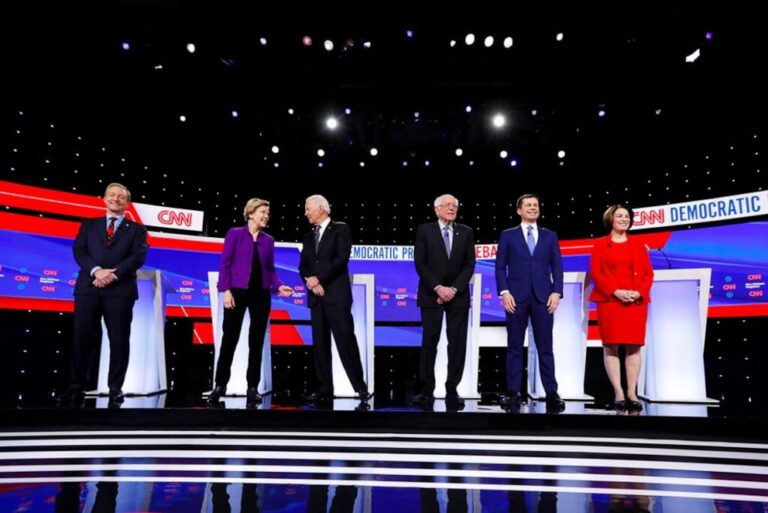
According to the DNC, five presidential primary debates will take place in 2027, with the first two scheduled for June and July.
The remaining seven debates will be held in 2028, including six in states selected for the early stages of the Democratic presidential nomination process.
Those states are South Carolina, Nevada, New Hampshire, New Mexico, Michigan and Virginia.
The party intends to conclude its debate schedule in March 2028, although officials have reserved the right to make changes as the nomination contest develops.
The arrangement closely resembles the party’s 2020 presidential primary process, which featured 11 debates beginning in June 2019.
Some of those debates were conducted over two nights to accommodate the large number of candidates seeking the nomination.
The DNC has indicated that a similar arrangement could be adopted in 2028 if the field of presidential contenders becomes particularly crowded.
One of the most significant changes announced by the Democratic National Committee is a new requirement designed to discourage the influence of dark money during the presidential primary.
Under the party’s Fair Campaign Practices Pledge, candidates must publicly reject qualifying political advertising financed by certain outside groups, including super political action committees and organizations that do not disclose their donors.
Dark money generally refers to political spending by organizations that are not required to publicly identify the people or entities financing their activities.
Super PACs, meanwhile, can raise and spend unlimited amounts of money to support or oppose political candidates, provided they operate independently of the campaigns.
Although the DNC cannot legally prohibit these organizations from spending money, it can establish participation requirements for its own presidential debates.
Candidates who fail to comply with the pledge could therefore lose their eligibility to appear on the debate stage.
The new rules also restrict joint fundraising arrangements between presidential primary campaigns and Democratic Party committees, an effort intended to maintain neutrality during the nomination contest.
The debate announcement follows a historic midterm election performance in which Democrats captured majority control of both the House of Representatives and the Senate.
The victories have strengthened the party’s political confidence as it prepares for the next presidential contest.
DNC Chairman Ken Martin said Democrats intend to maintain their momentum and build a competitive campaign capable of defeating Republicans in 2028.
Martin emphasized that the party’s debate process would be designed to promote transparency, encourage unity and help strengthen the eventual presidential nominee.
He also expressed confidence that the leadership team overseeing the debates would create a fair environment for candidates to present their policies and compete for voter support.
The Democratic National Committee says its debate arrangements will be supervised by an experienced leadership team, including senior adviser Minyon Moore and executive director Roger Lau.
The committee will establish qualification standards based on polling performance, grassroots fundraising and other measures of candidate support.
Specific requirements for the first two debates, including dates, locations and participating media organizations, are expected to be announced in January 2027.
The party also plans to limit the number of participants to 20 across two nights if more candidates qualify.
Officials say the measures are intended to create a competitive but manageable debate environment while giving voters an opportunity to assess the candidates seeking the nomination.
Although the 2028 presidential election remains nearly two years away, the DNC’s announcement signals that preparations for the next national political contest are gaining momentum.
President Donald Trump is constitutionally barred from seeking another elected presidential term, leaving Republicans to select a new candidate to defend the White House.
Democrats, meanwhile, face the challenge of translating their midterm victories into a successful presidential campaign.
The party must also navigate potential disagreements among its candidates over economic policy, immigration, national security and the direction of the Democratic Party.
By announcing the debate schedule well ahead of the election, Democratic leaders hope to establish clear rules, encourage policy discussions and provide voters with sufficient opportunities to evaluate presidential contenders.
The introduction of restrictions on dark money also signals an effort to address concerns about financial influence in American politics.
As the 2028 presidential race begins to take shape, the Democratic National Committee is positioning its debate process as a central part of the party’s strategy to maintain political momentum, strengthen its eventual nominee and regain control of the White House.