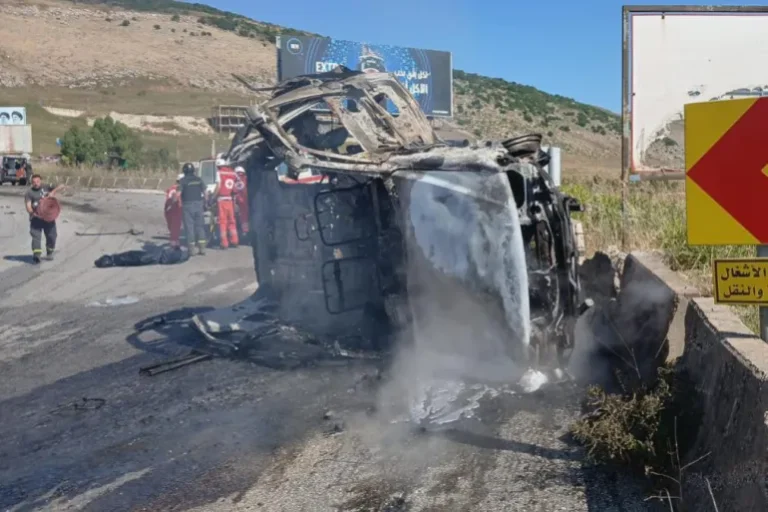
At least 12 people, including senior Lebanese military officers, were killed in Israeli attacks across southern Lebanon on Saturday, raising fresh concerns about the durability of a recently agreed ceasefire reached through U.S.-mediated negotiations.
The Lebanese Armed Forces said a brigadier general, a captain and a soldier were killed when an Israeli strike targeted a military vehicle traveling along the Khardali-Nabatieh road in southern Lebanon.
In a statement, the Israeli military said the area was considered an “active combat zone” and noted that movement within such zones requires prior coordination with Israeli forces. The military added that the circumstances surrounding the incident were under review.
Lebanon’s army condemned the attack, accusing Israel of carrying out deliberate and repeated assaults that undermine ongoing diplomatic efforts aimed at restoring stability.
“The continuation of the deliberate and repeated Israeli aggression is intended to obstruct all efforts to reach a solution,” the military said.
President Joseph Aoun denounced the strike as a “flagrant violation” of Lebanese sovereignty and international law.
Prime Minister Nawaf Salam described the attack as a “heinous crime” and an assault on both the Lebanese state and its people.
Salam extended condolences to the families of Brigadier General Wassam Sabra, Captain Elie Khoury and soldier Hussein Ghozal, as well as to the Lebanese Armed Forces.
The incident marks one of the deadliest attacks involving Lebanese military personnel since ceasefire discussions began and highlights the fragile security situation along the Israel-Lebanon border.
Later Saturday, the Lebanese army announced that its commander, General Rudolf Haykal, had departed for Pakistan to hold talks with Pakistani military chief Field Marshal Asim Munir.
The visit comes as Pakistan continues diplomatic efforts aimed at helping mediate broader regional negotiations focused on ending the conflict involving the United States, Israel and Iran.
Israeli military operations in Lebanon remain one of the key issues complicating those discussions, with regional mediators seeking to prevent further escalation and secure a more comprehensive ceasefire arrangement.
The latest strikes underscore the challenges facing diplomatic initiatives as violence continues despite ongoing efforts to reduce tensions across the region.