North Korea has revealed a new facility dedicated to producing material for nuclear weapons, with leader Kim Jong Un pledging to accelerate the expansion of the country’s nuclear capabilities at what he described as an “exponential rate.”
The announcement, made Thursday through state media, is the latest indication that Pyongyang intends to strengthen its nuclear program despite international pressure and ongoing sanctions.
According to the state-run Korean Central News Agency, Kim toured the facility on Wednesday alongside senior officials and reviewed plans aimed at significantly increasing the country’s nuclear weapons capacity.
During the visit, Kim said North Korea had established priorities for implementing an ambitious strategy designed to rapidly enhance the nation’s nuclear deterrent.
State media reported that the newly disclosed facility employs “more sophisticated technology” than previous sites but did not reveal its location or provide technical details about its operations.
South Korea’s military assessed the installation as a uranium enrichment facility and said it was closely coordinating with the United States to monitor developments related to North Korea’s nuclear activities.
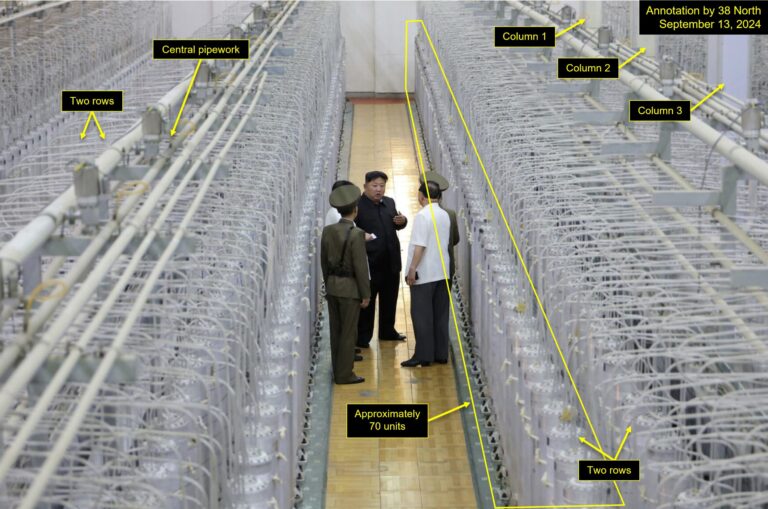
Photographs released by KCNA showed Kim walking through what appeared to be a centrifuge hall lined with rows of metallic tubes and piping, equipment commonly associated with uranium enrichment. Other images showed the North Korean leader meeting with senior officials around a table displaying a blurred graphic that appeared to depict a cone-shaped object, though it was unclear whether it represented a nuclear warhead design.
The disclosure marks the third time North Korea has publicly revealed a uranium enrichment facility. The country previously unveiled a covert enrichment plant in 2024 and, in 2010, allowed visiting American scholars to view a facility at its main nuclear complex in Yongbyon Nuclear Scientific Research Center.
Last year, South Korean Unification Minister Chung Dong-young said Pyongyang was operating four uranium enrichment facilities, including the Yongbyon complex, with all believed to be functioning continuously.
Kim used the visit to reiterate his government’s position that strengthening North Korea’s nuclear arsenal remains essential in the face of what he called threats from “the most ferocious enemies,” an apparent reference to the United States and South Korea.
He emphasized that North Korea’s status as a nuclear weapons state is non-negotiable and claimed the country’s capacity to produce nuclear materials has more than doubled over the past five years. Independent verification of that claim has not been possible.
Analysts say the latest move reflects Kim’s broader strategy of securing international recognition of North Korea as a nuclear power, which could strengthen his leverage in future negotiations and increase pressure for sanctions relief.
Many experts believe Pyongyang ultimately seeks arms-control discussions rather than complete denuclearization, hoping to exchange limits on portions of its arsenal for economic and political concessions.
U.S. President Donald Trump has repeatedly expressed interest in reviving diplomatic engagement with Kim. However, North Korea has insisted that Washington abandon demands for denuclearization as a prerequisite for renewed talks.
Since the collapse of U.S.-North Korea negotiations in 2019, Pyongyang has conducted numerous missile and weapons tests while repeatedly pledging to expand its nuclear forces.
Although many defense analysts now believe North Korea possesses missiles capable of reaching the U.S. mainland, some experts argue the country has yet to conclusively demonstrate key technologies necessary for a fully operational intercontinental nuclear deterrent, including reliable atmospheric reentry systems and the ability to deploy multiple nuclear warheads on a single missile.
The unveiling of the new facility is likely to intensify concerns among regional powers and Western governments about the continued growth of North Korea’s nuclear program and the challenges facing future diplomatic efforts.