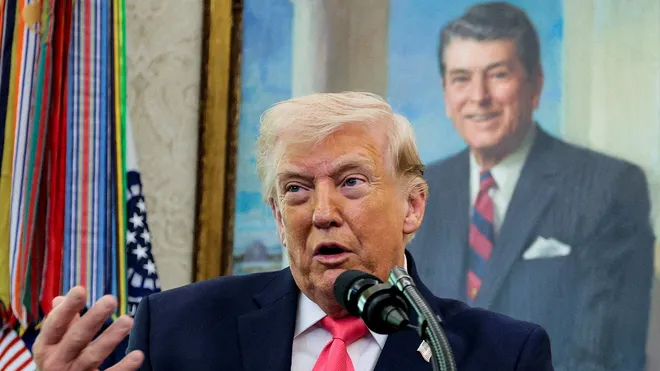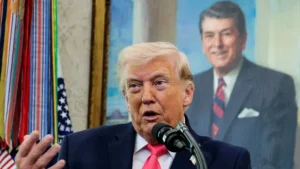
U.S. President Donald Trump has reportedly discussed the possibility of withdrawing from NATO, raising fresh concerns about the future of the decades-old transatlantic alliance.
At a White House briefing on Wednesday, Press Secretary Karoline Leavitt described the U.S.-Israel war against Iran as a “test” that NATO had failed, noting that allied nations declined to contribute combat forces beyond defensive support.
“They were tested, and they failed,” Leavitt said, quoting Trump. She added that it was “quite sad” that NATO allies had not more directly supported the United States, despite long-standing American contributions to their defense.
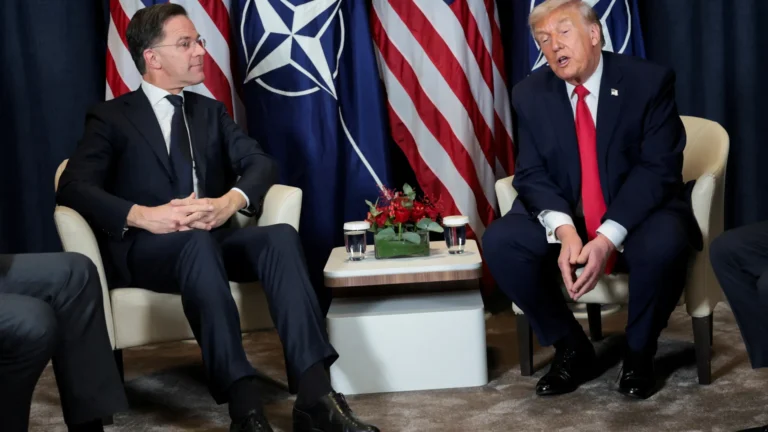
Her remarks came ahead of Trump’s meeting with NATO Secretary-General Mark Rutte at the White House. According to Leavitt, the president planned to have a “frank and candid conversation” about the alliance’s role and commitments.
Following the meeting, Rutte described the discussion as “frank and open” in an interview with CNN. While reaffirming his support for Trump, he emphasized that NATO members had provided logistical assistance and access to military bases during the conflict.
When asked whether Trump had signaled an intent to withdraw from NATO or scale back U.S. support, Rutte acknowledged “clear disappointment” from the president but said Trump was receptive to arguments about the alliance’s contributions.
Trump’s relationship with NATO has long been marked by tension. He has repeatedly criticized European allies for insufficient defense spending while at times reaffirming U.S. commitment to the alliance. Since returning to office in 2025, he has intensified pressure on member states to increase military budgets.
At the 2025 NATO summit, member countries agreed to nonbinding commitments to raise defense spending to 5 percent of gross domestic product by 2035. However, Spain sought an exemption, drawing repeated criticism from Trump.
Strains have extended beyond defense spending. In 2025, Trump sparked controversy by suggesting the U.S. could use military force to seize Greenland, a self-governing Danish territory, citing national security concerns. While those threats have since eased, he has continued to assert that U.S. control of Greenland is strategically necessary.
Tensions escalated further after the U.S. and Israel launched military operations against Iran on February 28. Trump criticized European allies for their limited involvement, while some legal experts have questioned the legality of the conflict under international law.
According to a report by The Wall Street Journal, the administration is also considering reducing its military footprint in Europe, including closing bases or withdrawing troops from countries such as Spain and Germany in response to their stance on the conflict.
When asked directly whether the United States might leave NATO, Leavitt said the president has “discussed” the possibility and could address it further following his talks with Rutte.
Despite current tensions, Trump and Rutte are considered to have a close working relationship. Rutte has visited the White House multiple times during Trump’s second term. He has previously warned that NATO’s effectiveness depends heavily on continued U.S. participation.