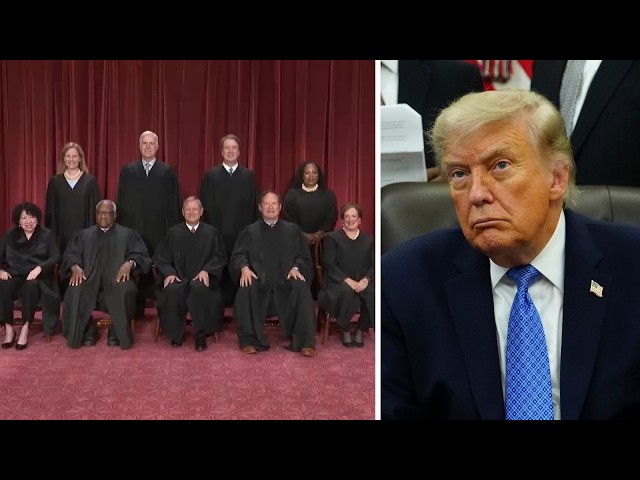
President Donald Trump has called on Congress to pursue legislation ending birthright citizenship after the U.S. Supreme Court rejected his effort to abolish the policy through executive action.
Responding to Tuesday’s ruling, Trump described the court’s decision as “too bad for the Country” but argued that lawmakers could still address the issue through legislation rather than a constitutional amendment.
“The Supreme Court upheld Birthright Citizenship, which is too bad for our Country, but we can easily make it up in Congress through Legislation,” Trump wrote on social media.
He urged Congress to begin work immediately on legislation aimed at ending what he called an “expensive and unfair” policy.
The Supreme Court rejected Trump’s executive order in a 6-3 decision. The order, signed on his first day back in office, sought to end automatic citizenship for children born in the United States under certain circumstances.
Writing for the majority, Chief Justice John Roberts emphasized that birthright citizenship is protected by the Fourteenth Amendment to the United States Constitution.
“Citizenship, then and now, was the right to have rights—to freely participate in our political community,” Roberts wrote. “The Framers of the Fourteenth Amendment extended that promise to every free-born person in this land. We keep that promise today.”
Birthright citizenship is grounded in both the Fourteenth Amendment and the Nationality Act of 1940, which codifies U.S. citizenship law.
Legal experts note that even if Congress were to pass legislation limiting birthright citizenship, such a law would almost certainly face immediate constitutional challenges.
Because the Supreme Court based its decision on the Constitution, any future legislative effort to alter birthright citizenship would likely return to the courts, with the possibility of another review by the nation’s highest judicial body.
The ruling represents a significant legal setback for Trump’s long-standing effort to reinterpret the scope of birthright citizenship, an issue that has remained at the center of immigration and constitutional debates in the United States.