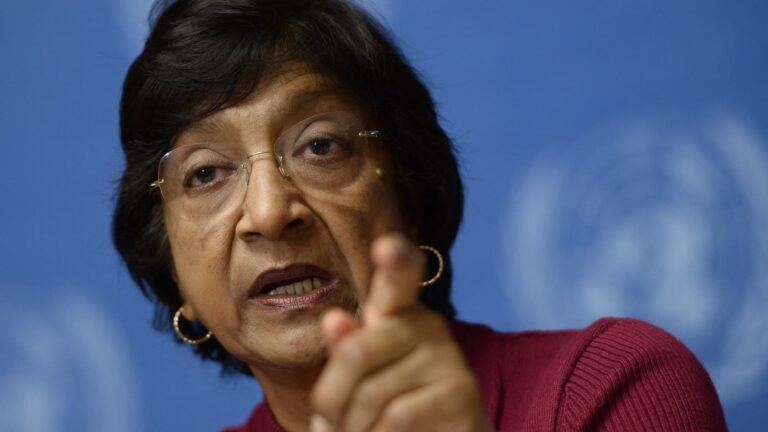
The Norwegian Nobel Committee announced the award Friday, honoring Pillay for her efforts to promote peace and strengthen international legal institutions.
Describing her as a woman of exceptional courage and integrity, the committee praised her contributions to the prosecution of war crimes, crimes against humanity and genocide.
Pillay, born in Durban, South Africa, in 1941, began her legal career during the apartheid era, challenging racial discrimination and defending individuals who opposed the country’s system of segregation.
Her career subsequently took her to some of the world’s most influential judicial and human rights institutions.
She served as a judge on South Africa’s High Court, the International Criminal Tribunal for Rwanda and the International Criminal Court. She also held the position of United Nations High Commissioner for Human Rights.
More recently, Pillay chaired the United Nations Independent International Commission of Inquiry on the Occupied Palestinian Territory, investigating allegations of human rights violations and breaches of international law.
Her work has also extended to legal proceedings involving allegations of genocide against Myanmar.
In announcing the award, the Nobel Committee highlighted Pillay’s role in demonstrating how international courts and legal mechanisms can help prevent violence, establish accountability and promote lasting peace.
The committee said her independence, legal expertise and unwavering commitment to justice have made her one of the most respected international jurists of her generation.
It also emphasized the importance of protecting judicial independence at a time when international courts and their officials face growing political pressure, criticism and sanctions.
According to the committee, the rule of law remains essential to maintaining international peace and resolving disputes without violence.
“Peace requires justice,” the Nobel Institute declared, underscoring the relationship between legal accountability and conflict prevention.
Pillay holds a Master of Laws degree and a Doctor of Juridical Science degree from Harvard University. Her legal career has spanned several decades, from confronting apartheid in South Africa to helping shape international human rights and criminal justice institutions.
The Nobel Committee said the award reflects the principles established in Alfred Nobel’s will, particularly the promotion of cooperation among nations and the advancement of peaceful conflict resolution.
Pillay’s recognition places renewed international attention on the role of courts, human rights protections and accountability in preventing atrocities and building sustainable peace.