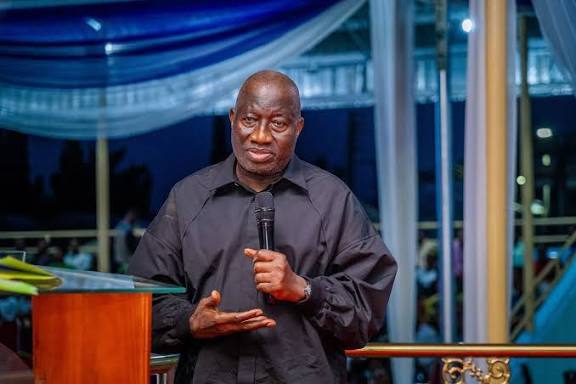
Former Nigerian President Goodluck Jonathan has criticised Nigeria’s leadership selection process, warning that the country cannot make meaningful progress if political appointments and elections continue to be influenced by religion, ethnicity, language and denomination rather than competence.
Jonathan spoke on Saturday in Lagos at the Herbert Macaulay Colloquium, organised to mark the 162nd birthday of the nationalist pioneer, who was born on November 14, 1864.
He described Nigeria’s approach to recruiting political leaders as primitive, arguing that even highly qualified individuals would struggle to deliver progress unless the country abandoned such considerations.
“We are still suffering from political leaders being recruited based on religion, language and all kinds of things,” Jonathan said.
“Sometimes it is even beyond Muslim or Christian. I know of a particular state in southern Nigeria that 99.9 per cent of them are Christians. But if you don’t belong to one particular denomination, you cannot be the governor of the state.
“That is the kind of thing we do. So no matter how good you are, until we move away from these primitive ways of recruiting political leaders, this country cannot go.”
The former president also identified poor leadership, weak institutions, corruption, policy inconsistency, inadequate infrastructure and insecurity as major obstacles to Nigeria’s development.
He called for far-reaching democratic reforms, describing the country’s current democratic system as “opaque and amorphous.”
According to him, Nigeria must rebuild its democratic institutions around popular participation, the rule of law, respect for human rights, judicial independence, accountability, pluralism and a vibrant civil society.
On education, Jonathan warned that the country could not achieve meaningful development without strengthening its schools and universities. He urged the government to invest in its brightest minds and establish research-driven, world-class universities, citing India, Singapore and South Korea as examples.
“You can’t go anywhere with weak educational institutions,” he said.
Jonathan concluded by paying tribute to Herbert Macaulay and other founding nationalists, stressing that the most meaningful way to honour their contributions was not merely to celebrate their sacrifices but to build the kind of nation they fought for.