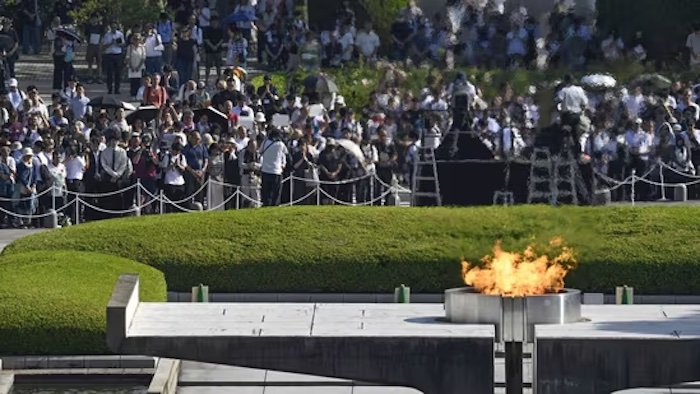
Japan observed a somber moment of silence on Wednesday to commemorate the 80th anniversary of the atomic bombing of Hiroshima, a defining event in world history that claimed more than 200,000 lives and ushered in the nuclear age.
At exactly 8:15 a.m.—the time when the U.S. dropped the atomic bomb on August 6, 1945—bells tolled across the city. Prime Minister Shigeru Ishiba, survivors, foreign dignitaries, and thousands of citizens gathered at Hiroshima’s Peace Memorial Park to honor the victims and reflect on the enduring legacy of the attack.
In his annual address, Hiroshima Mayor Kazumi Matsui delivered a pointed message to the global community, warning of a renewed global arms race and the resurgence of nuclear deterrence policies.
“There is a growing and dangerous belief that nuclear weapons are necessary for national security,” Matsui said. “This represents a complete disregard for the lessons humanity should have learned from past tragedies.”
The anniversary comes at a time of escalating global conflict, with nuclear threats resurfacing amid Russia’s invasion of Ukraine, tensions in East Asia, and broader shifts in geopolitical stability.
Survivors of the bombing, known as hibakusha, shared haunting recollections of that day. Shingo Naito, now 86, was six years old when the bomb exploded over Hiroshima. He recounted the devastating scene of his father’s injuries: “His skin was hanging, he was blinded, and he couldn’t even hold my hand.”
Naito now works with local students to preserve these memories through art, hoping to instill a lasting message of peace in future generations.
Another survivor, Satoshi Tanaka, who has battled multiple cancers linked to radiation exposure, said watching recent wars unfold in Gaza and Ukraine has reopened painful memories.
“The images of cities in ruins and families fleeing in terror—it all comes back,” he said. “We still live in a world where nuclear weapons can destroy humanity many times over.”
Tanaka issued a call to action, urging citizens worldwide to pressure their governments to disarm. “We cannot stay silent. We must speak louder, demand more, and act collectively to ensure this never happens again.”
As Japan remembered the victims of Hiroshima, the ceremony served as both a memorial and a global warning—echoing the urgent need for disarmament and diplomacy in an increasingly unstable world.