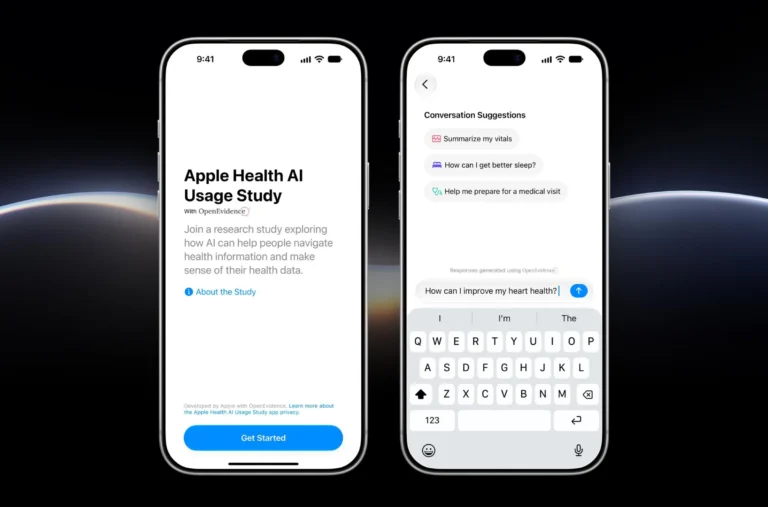
The initiative, announced Sunday, November 15, introduces the Apple Health AI Usage Study, a dedicated application designed to explore how artificial intelligence can help individuals better understand their health conditions and make informed decisions about their medical care.
The announcement comes as more people turn to AI-powered chatbots for answers to health-related questions, raising concerns among medical professionals about the accuracy, reliability and safety of information provided by such platforms.
Apple says its new approach will prioritize medically supported information, allowing participants to receive responses grounded in trusted scientific research and, with their permission, their personal health data.
Apple Partners With Medical AI Platform OpenEvidence
The research project is being conducted in collaboration with OpenEvidence, an artificial intelligence platform widely used by healthcare professionals to access medical information from established scientific publications.
Unlike conventional AI chatbots that generate responses using a broad range of information sources, the study application will provide answers supported by peer-reviewed clinical research.
Participants will also be able to view citations and links to the medical studies supporting the information they receive, allowing them to understand where the responses originate.
OpenEvidence draws on respected medical publications, including The New England Journal of Medicine, The Journal of the American Medical Association and Nature.
While the full OpenEvidence platform is currently designed for healthcare professionals and often presents information using specialized medical terminology, Apple says its technology will help translate the research into simpler language that everyday users can understand.
Study Will Examine Trust and Understanding of AI Health Advice
A central objective of the initiative is to determine how people interact with AI-generated medical information and whether they can understand and use it effectively.
Researchers will evaluate participants’ trust in AI responses, the clarity and usefulness of the information provided, and whether the technology helps individuals communicate more effectively with their doctors.
Dr. Sumbul Desai, Apple’s vice president of Health and Fitness, emphasized the importance of developing responsible AI tools that support rather than replace traditional healthcare services.
Desai explained that access to clear, medically grounded information could help patients feel more confident and prepared when attending medical appointments.
She also stressed that carefully examining how people use and interpret health-related AI responses is essential to ensuring the technology improves healthcare experiences rather than creating additional obstacles.
Users Can Choose to Share Personal Health Information
The study will also examine whether incorporating personal health information makes AI-generated responses more relevant and useful.
Participants will have the option to share selected information already stored in Apple’s Health application, including resting heart rate, physical activity, sleep patterns and laboratory test results.
For example, someone seeking information about improving their heart health could receive explanations informed by their own health measurements rather than relying exclusively on general medical guidance.
Apple emphasized that sharing personal health information is voluntary and that participants will remain in control of the data they choose to provide.
The company says the study includes privacy safeguards designed to protect sensitive medical information and that study data will not be used to train AI models.
Apple Seeks Up to 200,000 Participants
The research initiative is open to as many as 200,000 eligible adults across the United States.
Participants must be at least 21 years old and have an Apple Intelligence-compatible iPhone, beginning with the iPhone 15 Pro, running iOS 26 or later.
Users who enroll will be able to ask everyday health questions, evaluate the quality of the responses and provide feedback through surveys.
The study will also examine whether access to understandable medical research improves patients’ preparation for appointments and their ability to discuss health concerns with medical professionals.
However, Apple has emphasized that the application is intended for research and educational purposes. It is not designed to diagnose medical conditions, provide treatment or replace professional medical advice.
Growing Demand for Safer AI Healthcare Tools
The initiative reflects increasing interest in using artificial intelligence to support healthcare as more consumers rely on digital platforms for information about symptoms, medications and medical conditions.
Although AI technology has demonstrated potential in interpreting medical information, experts warn that inaccurate, incomplete or confusing responses could mislead patients or delay necessary treatment.
By combining established clinical research with personalized health information and clear explanations, Apple hopes to better understand how AI can become a useful companion in healthcare decision-making.
The company also intends to use insights from the research to inform future health technology development and contribute to wider scientific discussions about responsible artificial intelligence.
As AI continues to transform healthcare, Apple’s latest initiative represents an effort to establish greater trust, transparency and accountability in the way medical information is delivered to the public.
The study’s findings could help shape the next generation of digital health tools, potentially improving how patients understand their health and interact with healthcare professionals.