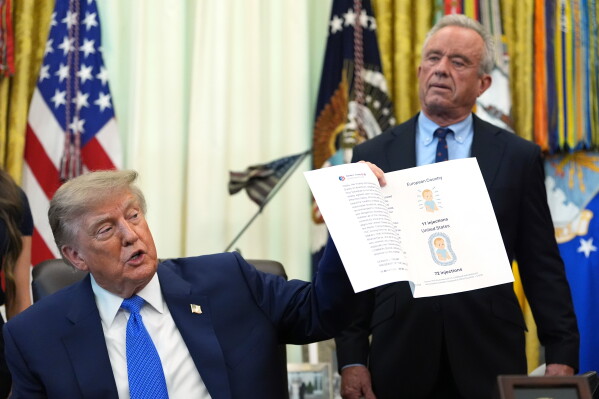
President Donald Trump signed an executive order Monday recommending changes to the U.S. childhood vaccination schedule, including separating the combined measles, mumps and rubella vaccine into three individual shots.
The order is not expected to immediately affect families’ access to vaccines and is likely to face legal challenges.
Announcing the measure before signing it, Trump described the recommendations as a new “gold standard” for childhood vaccination and again raised the issue of autism.
The move has drawn strong criticism from medical and public health organizations, which point to decades of research supporting the safety and effectiveness of recommended childhood vaccines. Extensive scientific research has also found no causal link between vaccines and autism.
Dr. Jan K. Carney, president of the American College of Physicians, criticized the administration for seeking to alter vaccine recommendations without relying on the established scientific review process traditionally used to determine the U.S. childhood immunization schedule.
“This executive order is part of a troubling pattern by the administration to attempt to unilaterally change vaccine guidance, particularly for children,” Carney said.
The American Academy of Pediatrics has also raised practical concerns about separating the MMR vaccine, estimating that developing individual vaccines for measles, mumps and rubella could take as long as a decade.
Republican Senator Bill Cassidy, a physician, publicly opposed the executive order and challenged the administration’s approach.
“I’m a doctor. This executive order is wrong,” Cassidy wrote on social media. “The President does not have the expertise to make these changes.”
Cassidy emphasized that vaccines are overwhelmingly safe and effective and said they do not cause autism.
Trump, however, argued that children decades ago received far fewer vaccines than those included in today’s recommended immunization schedule.
The executive order is expected to intensify the national debate over vaccine policy, particularly over whether decisions about childhood immunizations should remain primarily driven by established scientific and public health review processes.