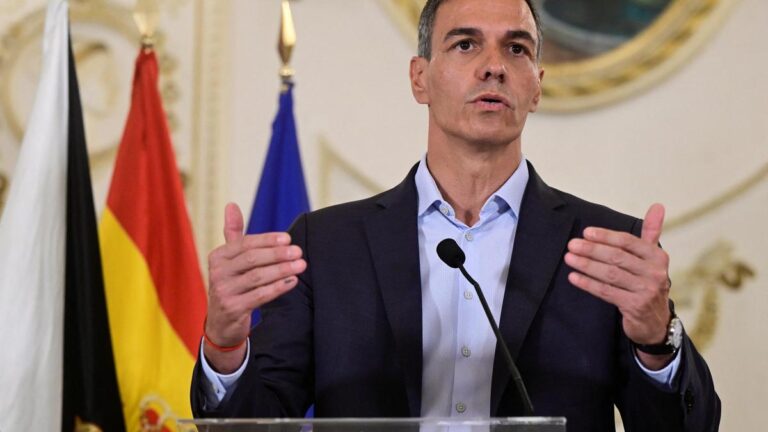
Spanish Prime Minister Pedro Sánchez is facing mounting criticism over his government’s migration policies as European Union leaders gather Tuesday to address the fallout from last week’s mass influx of migrants into the Spanish enclave of Ceuta in North Africa.
An estimated 50,000 to 60,000 migrants entered Ceuta on Thursday and Friday, triggering a humanitarian emergency and reigniting divisions within the European Union over migration policy.
Although most of the migrants later returned, Spanish and Moroccan authorities said more than 80 people died during the crisis, including migrants who drowned or were crushed in a stampede while attempting to cross a breakwater into the territory.
The incident has intensified political tensions across the 27-member bloc, with leaders from 22 EU countries signing an open letter criticizing Spain’s approach to migration.
The coordinated criticism—and Sánchez’s swift response—has exposed widening divisions between governments advocating tougher border controls and the Spanish leader, whose positions on migration, NATO spending and the conflicts in Gaza and Israel have frequently put him at odds with several European partners.
Spain’s government dismissed the criticism as politically motivated, arguing that authorities, working closely with Morocco, managed to return most of the migrants within hours despite receiving limited assistance from other European countries.
Officials said the operation was carried out in close coordination with Moroccan authorities and helped prevent an even larger humanitarian crisis.
Regardless of the outcome of Tuesday’s summit, analysts say the dispute highlights broader fractures within the European Union at a time when the bloc faces growing geopolitical and economic challenges.
“Europe has shown weakness again—massive weakness,” said Alicia García-Herrero, chief economist for Asia Pacific and the Middle East at financial services firm Natixis.
The criticism intensified after videos of the chaotic crossings in Ceuta spread widely on social media.
Several European leaders argued that Spain’s migration policies had encouraged the influx and called for stricter controls at maritime, land and air borders across the EU.
The open letter signed by 22 member states also pointed to a recent ruling by Spain’s Supreme Court, claiming it had contributed to the crisis.
The court ruled that migrants arriving by sea cannot be immediately deported without due process, unlike those who enter Ceuta by crossing land borders or climbing the enclave’s border fence because they have not crossed a physical land barrier.
Sánchez rejected suggestions that the ruling had weakened border security, arguing instead that migrant smuggling networks had deliberately misrepresented the decision to persuade thousands of people to attempt the dangerous sea crossing.
The debate is expected to dominate discussions among EU leaders as they seek a common response to one of the bloc’s most politically sensitive issues.