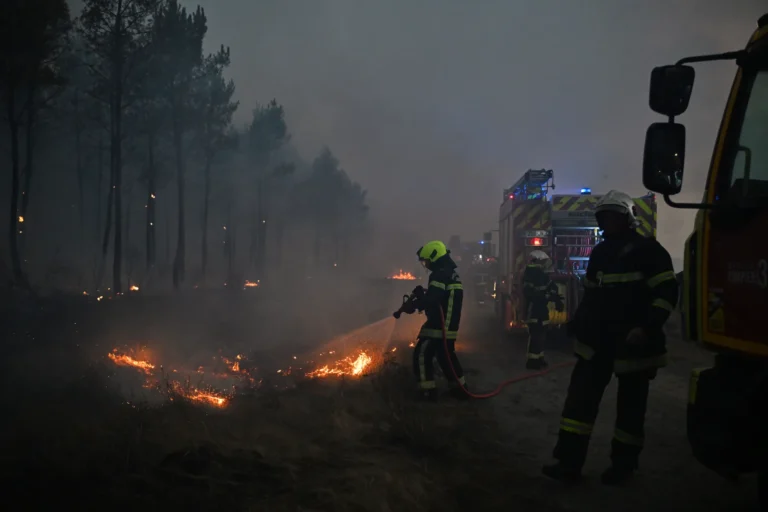
French President Emmanuel Macron convened an emergency government meeting on Monday as authorities battled massive, uncontrolled wildfires that have forced more than 250,000 people to evacuate across France, with officials reporting the first signs that the country’s largest blaze may be slowing.
In the southwestern Gironde region, where wildfires have scorched an area nearly four times the size of Paris, local authorities said conditions overnight remained “globally stable,” marking a notable improvement after days of rapid fire growth that threatened the outskirts of Bordeaux.
Officials cautioned, however, that the situation remains fragile and firefighters continue to work around the clock to prevent the flames from spreading.
In the neighboring Landes region, emergency crews made further progress against another major wildfire. Local officials said light overnight rainfall had created more favorable firefighting conditions but warned that changing weather could quickly reverse those gains.
No additional evacuation orders were issued overnight.
With France entering its peak summer holiday season, authorities in Gironde imposed new restrictions to keep visitors away from fire-affected areas, including banning children’s holiday camps and camps for people with disabilities.
Thousands of firefighters, supported by aircraft dropping water and fire retardant, continued an extensive operation on the ground and from the air in a race to contain the blazes before temperatures are forecast to rise sharply beginning Tuesday.
Macron was scheduled to chair the government’s emergency crisis meeting on Monday morning to coordinate the national response.
In a message posted over the weekend, the French president pledged long-term support for communities devastated by the fires.
“We will rebuild, we will repair and we will be present for as long as necessary,” Macron said.
The wildfire crisis extends beyond France.
In Spain, authorities continue to battle major fires around Madrid and in the Valencia region, where approximately 76,000 people have been evacuated and another 30,000 have been instructed to remain indoors because of dangerous fire conditions.
The unprecedented scale of the wildfires in both countries has intensified concerns over the impact of climate change, with prolonged heatwaves and exceptionally dry conditions creating ideal conditions for fast-moving and destructive blazes.
Spanish Prime Minister Pedro Sánchez said the fires reflect a broader climate emergency rather than isolated disasters.
“What we are experiencing is not a series of isolated incidents. It is the consequence of a climate emergency that is making wildfires even more violent and heat waves more frequent,” Sánchez said.
As firefighters continue their efforts, thousands of displaced residents remain uncertain about the fate of their homes and communities while awaiting permission to return to fire-ravaged areas.