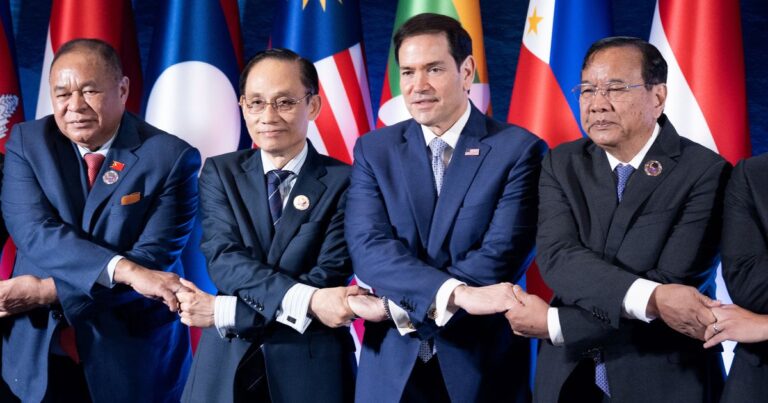
U.S. Secretary of State Marco Rubio warned Asian leaders on Wednesday that Iran’s efforts to control shipping through the Strait of Hormuz and impose transit fees could endanger the global economy and establish a dangerous international precedent.
Speaking at the opening of the Association of Southeast Asian Nations (ASEAN) foreign ministers’ meeting in Manila, Rubio said allowing any country to dominate an international waterway would have consequences far beyond the Middle East.
“If we create a precedent in the Middle East where a nation state can decide that they are going to control an international waterway, charge a toll and if you don’t pay them, blow up your ships, we have created a very dangerous precedent which will repeat itself in other parts of the world, including in this region,” Rubio said.
His remarks come as Southeast Asian nations express growing concern over the renewed conflict in the Middle East, which has disrupted global trade routes and affected economies across Asia.
Despite Washington’s increasing focus on the regional conflict, Rubio sought to reassure ASEAN members of the United States’ continued commitment to the bloc.
“We’re with ASEAN 100%,” he told regional leaders.
Rubio also renewed U.S. accusations that Iran has failed to honor commitments made under a previous peace agreement.
He said Tehran had continued to reach out to Washington through both direct and indirect channels in an effort to reopen negotiations over their differences.
However, Rubio gave no indication that the United States was prepared to resume formal peace talks with Iran.
Foreign ministers and senior diplomats from the United States, China, Russia and several other nations are attending this week’s ASEAN ministerial meetings in the Philippine capital.
British Foreign Secretary Ed Miliband is also expected to participate after arriving in Manila on Wednesday, according to his office.
The annual ASEAN gathering comes against the backdrop of heightened geopolitical tensions, with the conflict in the Middle East and concerns over maritime security expected to dominate discussions among regional and global leaders.