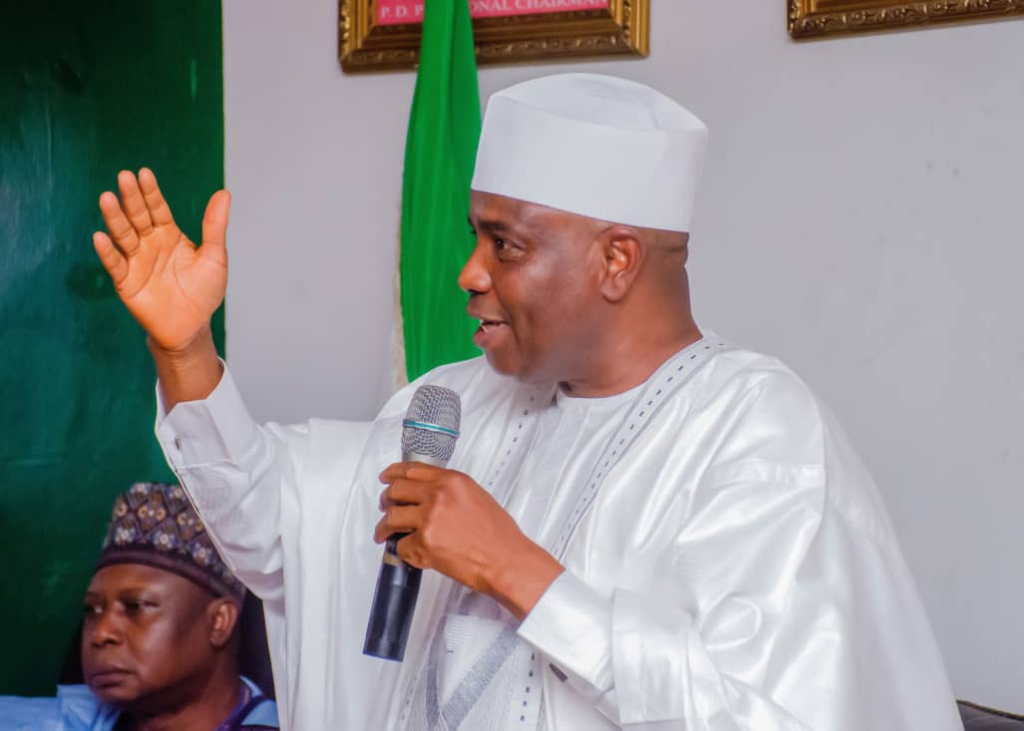
President Bola Tinubu has urged international financial institutions, including the World Bank, International Monetary Fund (IMF), and African Development Bank (AfDB), to increase funding for climate action, stressing that the world faces a crisis that requires “courageous and sustained leadership.”
Tinubu, represented by Vice-President Kashim Shettima, made the appeal at a Climate Summit during the 80th United Nations General Assembly (UNGA) in New York.
He disclosed that Nigeria is mobilising between $20 billion and $25 billion in climate finance by 2030 through green bonds, blended finance, and public-private risk-sharing mechanisms. The government also aims to secure $7–$10 billion in grants and concessional finance from global partners while advancing technology transfer, regional energy integration, and green entrepreneurship.
“For Nigeria, a country acutely vulnerable to climate impacts, climate action is not a choice; it is an existential necessity,” Tinubu said.
The president highlighted key domestic reforms designed to attract investment, including tax law simplification, removal of unproductive fossil fuel subsidies, and policies improving the ease of doing business. In March 2025, Nigeria introduced the Nigeria Carbon Market Activation Policy, which aims to position the country as a credible hub for carbon trading and mobilise $2.5 billion by 2030.
He further announced that Nigeria submitted its enhanced Nationally Determined Contributions (NDC 3.0) to the UNFCCC on September 21. The new plan integrates mitigation and adaptation measures with clear, economy-wide targets, surpassing the scope of NDC 2.0.
Among Nigeria’s commitments are reducing the deforestation rate by 60 percent (with a mitigation potential of 304.8 MtCO2eq), expanding reforestation and afforestation (34.4 MtCO2eq), scaling renewable and gas-based captive power generation to seven gigawatts, electrifying transport and industry, and enforcing national energy efficiency standards.
For the first time, “Health” and “Action for Climate Empowerment” have been included as priority sectors. Nigeria also plans to expand climate-smart agriculture to five million smallholder farmers by 2030, boost yields by up to 30 percent, promote drought-resistant crops, and restore ecosystems such as mangroves and wetlands to enhance carbon sinks by 200 MtCO2e.
On the institutional front, Tinubu noted the establishment of the National Council on Climate Change (NCCC) with a cross-ministerial Secretariat to drive coherence, accountability, and measurable results.
Reaffirming Nigeria’s leadership role, Tinubu declared: “Climate action is not a trade-off between growth and sustainability; it is the pathway to sustainable growth, innovation, security, and shared prosperity. The time for climate action is now.”