Illinois Governor JB Pritzker issued a strong rebuke Friday to President Donald Trump’s plan to deploy National Guard troops to Chicago, calling it an overreach of federal authority and an unjustified response to the city’s conditions.
“There is no emergency that justifies the National Guard being sent to Illinois,” Pritzker said in a statement. “The president is attempting to manufacture a crisis where none exists.”
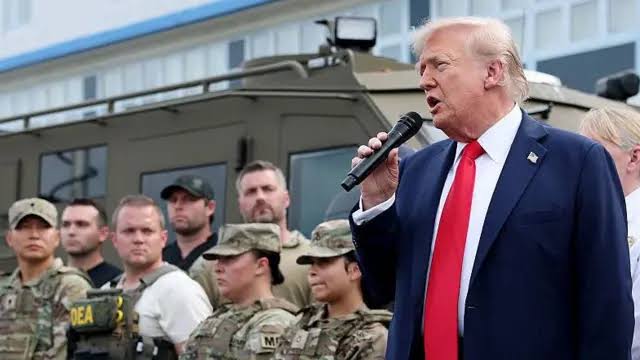
The response follows Trump’s deployment of approximately 2,000 National Guard members to Washington, D.C., as part of what the administration describes as a broader effort to address violent crime in U.S. cities. Citing the Washington deployment as a model, Trump indicated that similar actions may soon be taken in Chicago and New York. “DC was a hellhole, but now it’s safe,” he remarked after meeting with troops stationed in the capital.
Chicago Mayor Brandon Johnson stated that his administration had received no formal notification from federal authorities about any such deployment. He warned that uncoordinated military action could escalate tensions between residents and law enforcement, undermining public safety efforts already underway. “The president’s approach is uncoordinated, uncalled for, and unsound,” Johnson said.
Meanwhile, U.S. Secretary of Defense Pete Hegseth announced that National Guard units in Washington would now be permitted to carry weapons, reversing an earlier policy that restricted them to unarmed support roles. The Pentagon stated that the change aligns with their operational mandate, though the scope of their duties remains primarily limited to patrol and security presence near key landmarks, such as the National Mall and Union Station.
The administration has credited the federal intervention with results. Attorney General Pam Bondi reported over 700 arrests and the confiscation of 91 illegal firearms during the operation in Washington.
However, local leaders have questioned the necessity and legality of the deployment. Washington Mayor Muriel Bowser has not yet commented on the new directive to arm troops but previously emphasized that the city was experiencing historically low levels of violent crime.
Public opposition to the federal strategy is also significant. A recent poll conducted by The Washington Post and the Schar School found that nearly 80% of D.C. residents oppose both the National Guard presence and any federal control over local police operations.
Despite growing resistance, Trump has indicated he may invoke emergency powers to extend or expand military presence beyond the initial 30-day period. “If I think we’re in great shape here, that’s one thing. But if I don’t, I’m just going to say it’s a national emergency,” he said.
According to internal reports, up to 1,700 National Guard troops could be activated across 19 states in the coming weeks. Texas is expected to receive the largest contingent, and several Republican-led states—including South Carolina and West Virginia—have already pledged support.
In addition to security measures, the president said he plans to ask Congress for $2 billion to fund improvements and beautification efforts in Washington, despite a recent $1.1 billion cut to the city’s federal funding.